All posts by Eric

Support for Angels of Light Archive Project

Link to the GoFundMe: https://gofund.me/b5046cccf

The Angels of Light Free Theatre were one of the most dazzling offshoots of the San Francisco counterculture. Emerging in 1970 from the spirit of the Diggers and Kaliflower communes, the Angels dedicated themselves to creating free theater for the people of the city. Their shows were kaleidoscopic pageants of color, costume, and imagination—part Greek tragedy, part acid vaudeville, part street carnival—performed in parks, warehouses, lofts, or wherever an audience could gather. The Angels believed that art should never be sold, only shared. Their performances, given without charge, invited everyone present to step into a world of collective joy and transformative possibility.

Debra “Beaver” Bauer was one of the core members of the Angels of Light. Aside from her skill as a performer and designer, she has been the guardian of the Angels’ creative legacy. For decades, Beaver has carefully curated an extraordinary archive: photographs, drawings, costumes, scripts, music, sets, masks, props, programs, posters, announcements, and the lived stories of a communal troupe that redefined what theater could be.

Recently, Beaver uncovered a rare treasure: six Super 8 film canisters shot by fellow Angel Brian Mulhern between 1972 and 1979. These reels contain living history—performances, gatherings, and glimpses into the communal magic of the Angels of Light—that have never been seen outside their circle. One of the main goals of this GoFundMe is to digitize these films at the highest 1080p resolution, ensuring their survival for future generations.

We also want to help Beaver continue her curatorial work. She has been relying on a ten-year-old computer that is now on its last legs. A new computer will allow her to preserve, catalog, and present the Angels archive in ways that match the brilliance of the material itself.

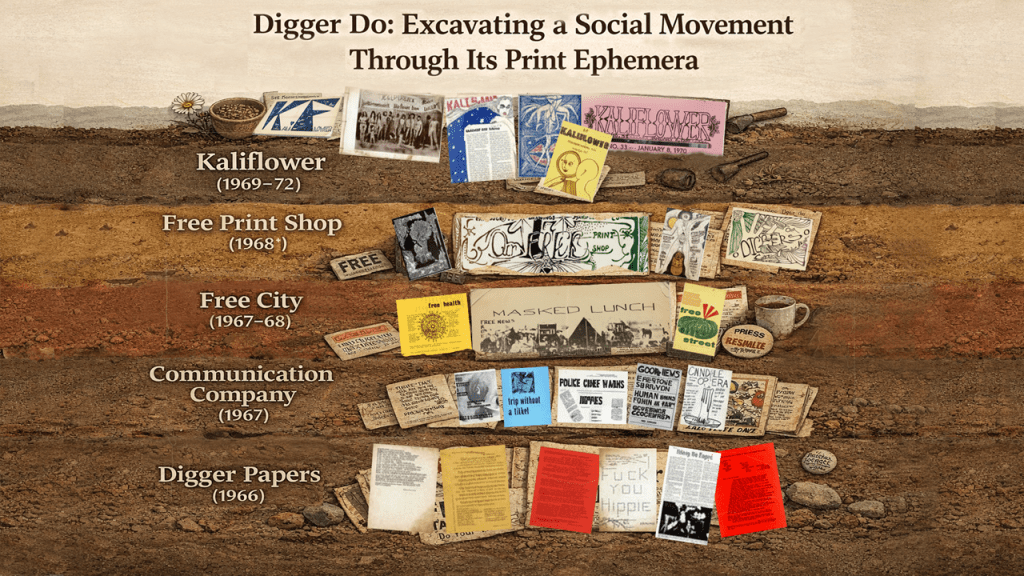
This project is sponsored by The Digger Archives, which has long been dedicated to preserving and sharing the legacy of the Diggers, Kaliflower, and the many free cultural movements that sprang from them. Supporting this campaign means helping to keep alive one of the most visionary communal art experiments in San Francisco’s history.

The Angels of Light taught us that beauty and generosity can change the world. With your support, Beaver can continue to safeguard their vision and make it accessible to artists, historians, and dreamers everywhere. Please help us honor this extraordinary legacy. Every contribution brings the Angels’ shimmering, communal light one step closer to being preserved for all time.

Thank you for your support.

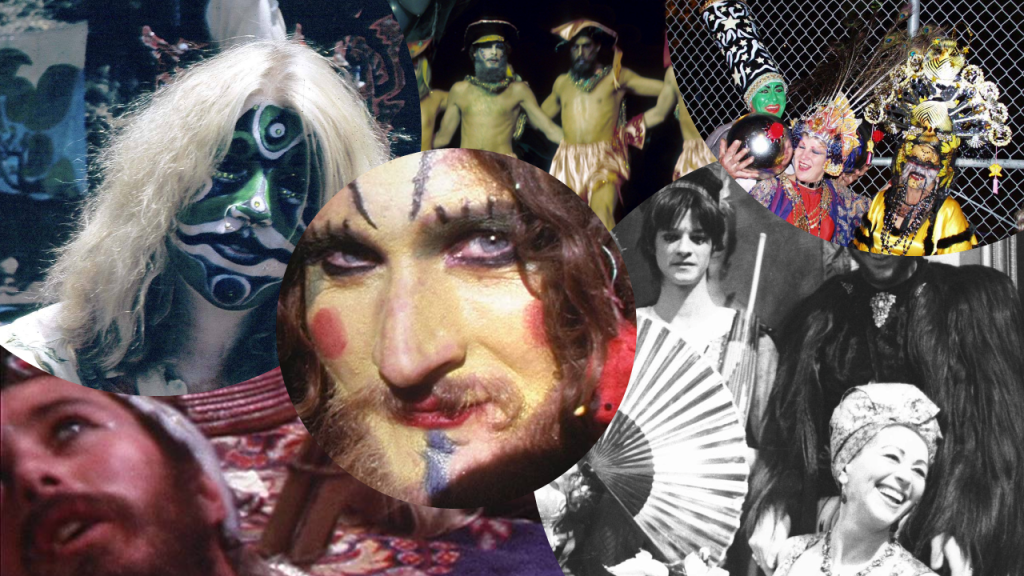
P.S. In the photo collage at the top of this page, that’s Beaver in the upper right corner wearing red and purple, costumed and radiant as ever, embodying the spirit of the Angels of Light.

What We’re Raising Funds For

  1. Digitization of six Super 8 film canisters (footage by Brian Mulhern, 1972–1979)
    – Cost: $691.40
  2. External hard drives to safely store and back up the digitized films and archival materials
    – Cost: $130.32
  3. A new MacBook Air to replace Beaver’s ten-year-old computer, giving her the tools she needs to continue curating, cataloging, and sharing the archive
    – Cost: $1,954.16

Total: $2,775.88

If we are fortunate enough to raise more than this goal, the additional funds will be set aside for future Angels of Light archival projects—ensuring that more of this remarkable history can be preserved and shared.

Link to the GoFundMe: https://gofund.me/b5046cccf

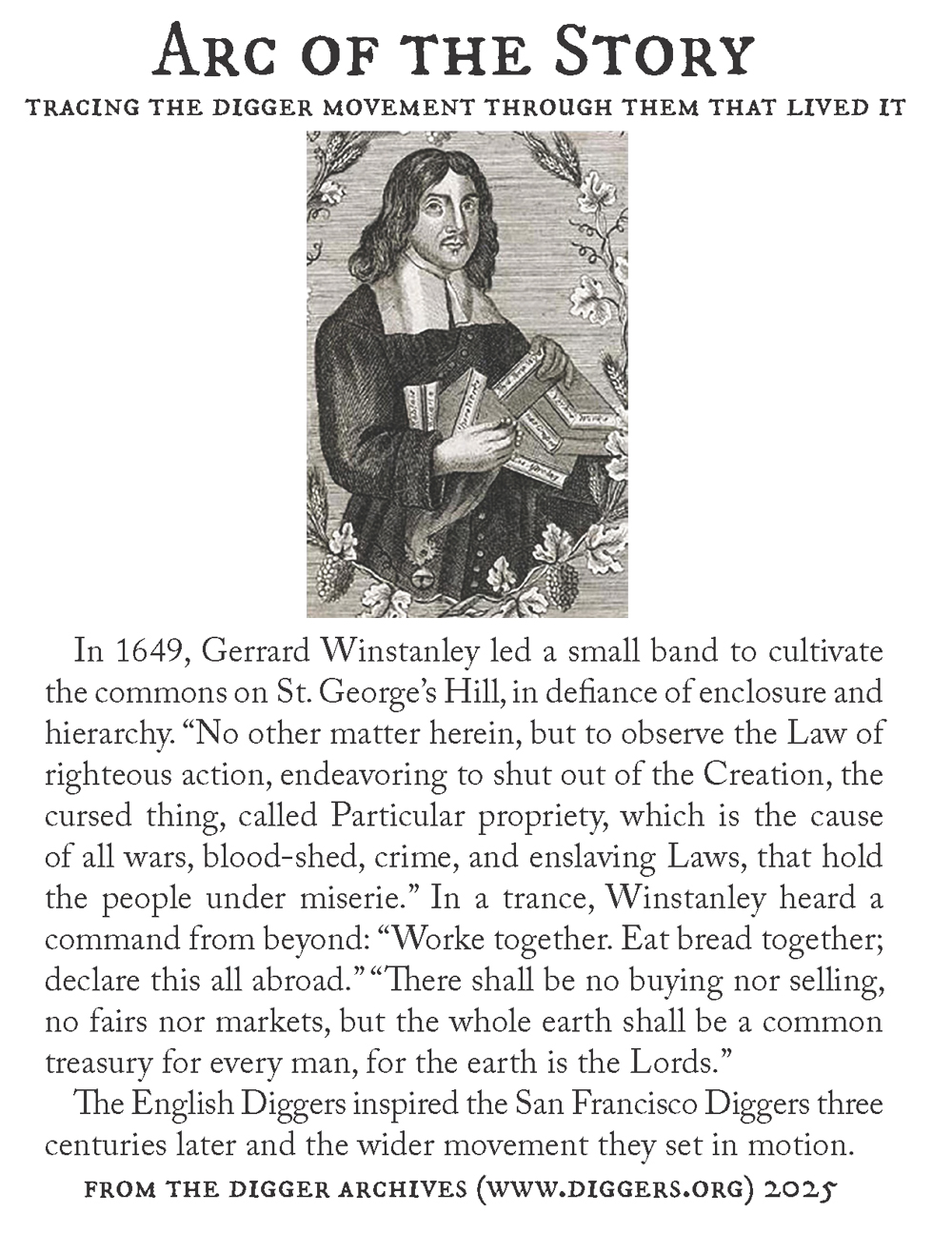
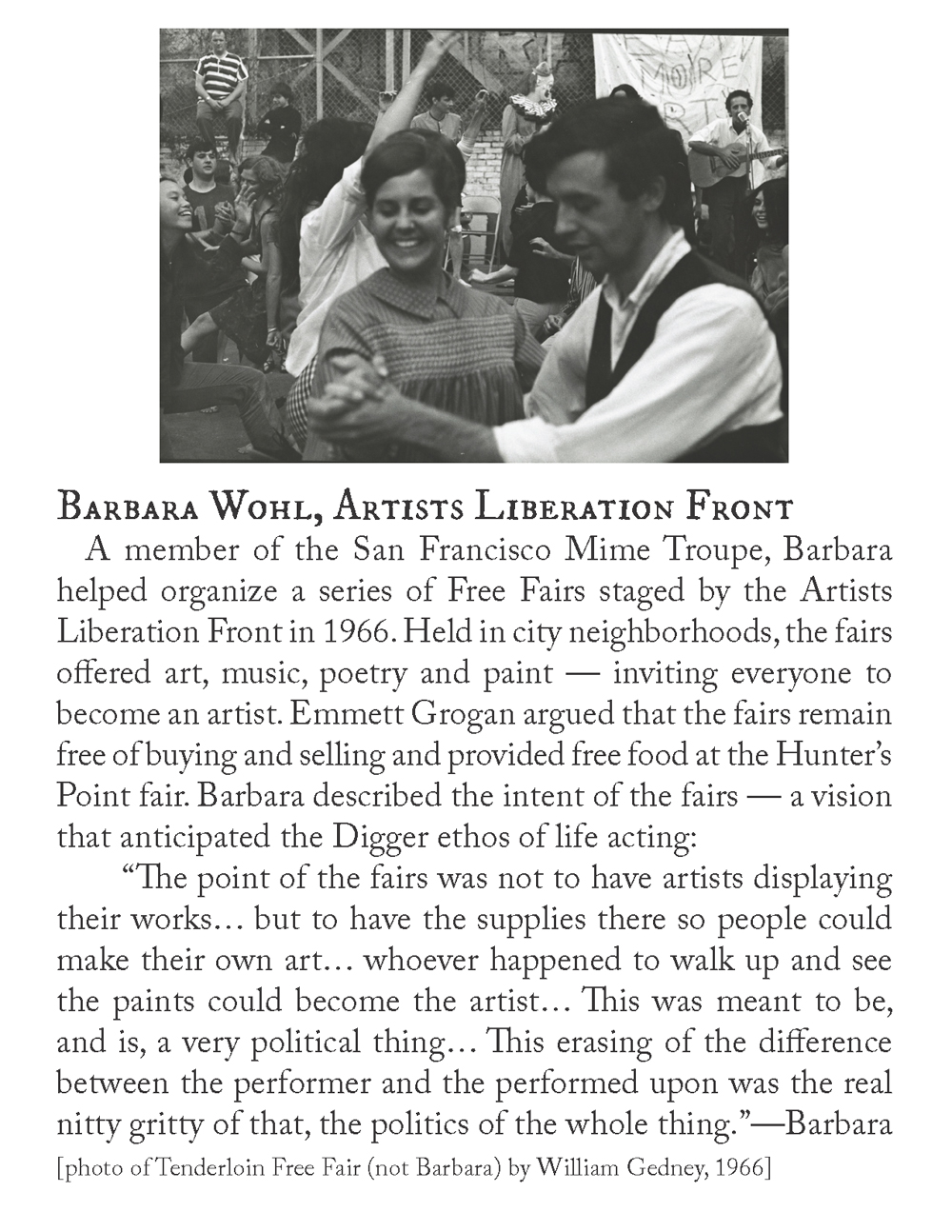
Arc of the Story

Tracing the Digger Movement Through Them That Lived It

This is the program for a talk that I presented at the closing event for the Our Commons Are Free exhibition at Fort Mason in San Francisco last month (August 9, 2025). The booklet was printed “fan-fold” style and measured 4-1/4″ x 5-1/2″.

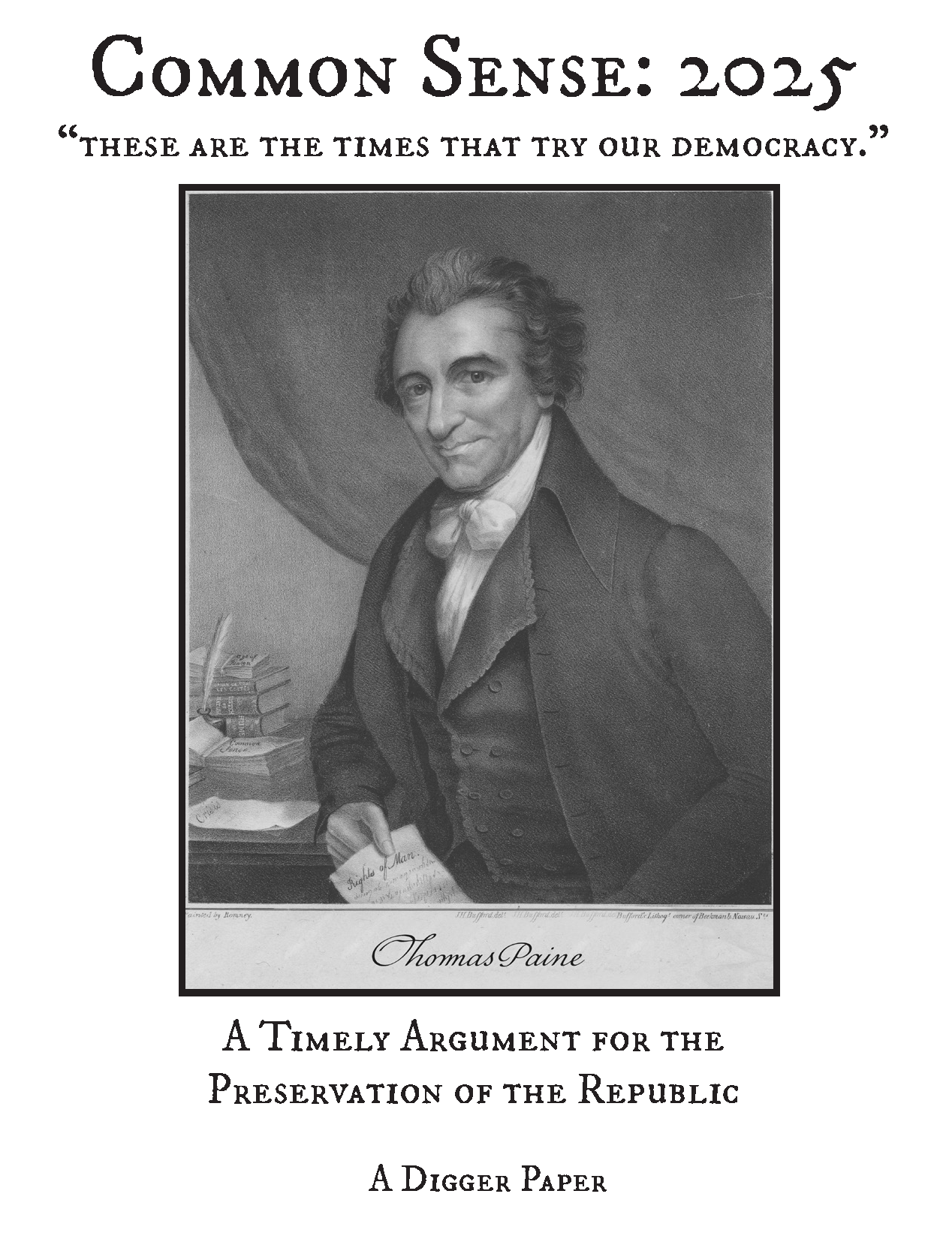
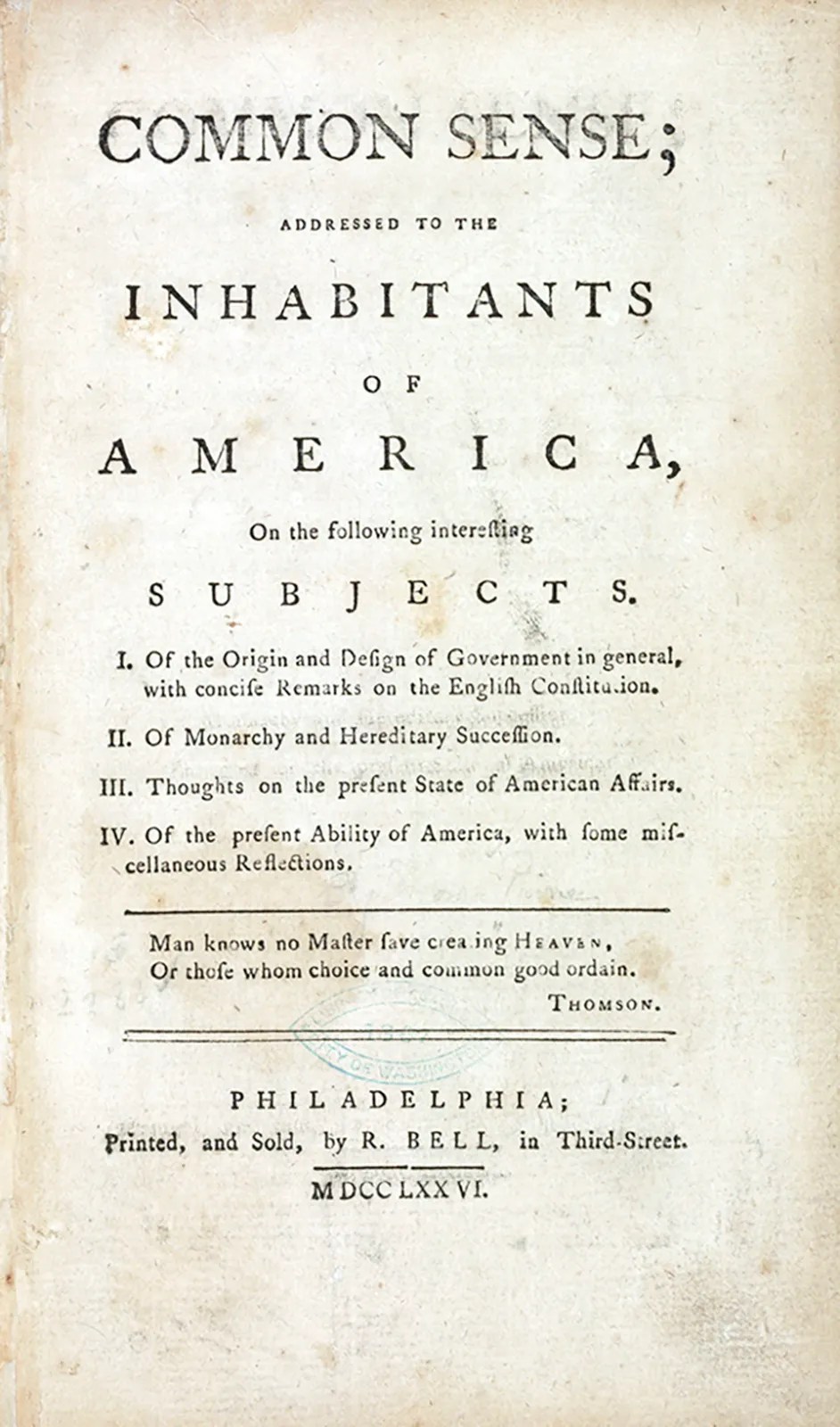
Common Sense 2025: a timely argument for the preservation of the Republic

“These are the times that try our democracy”
A Digger Paper

On the Summer Solstice 2025, at the Our Commons Are Free exhibit at Fort Mason in San Francisco, the Diggers distributed a new Digger Paper. It was a fan-fold booklet similar to a street zine. Here is the text and the images of each page.

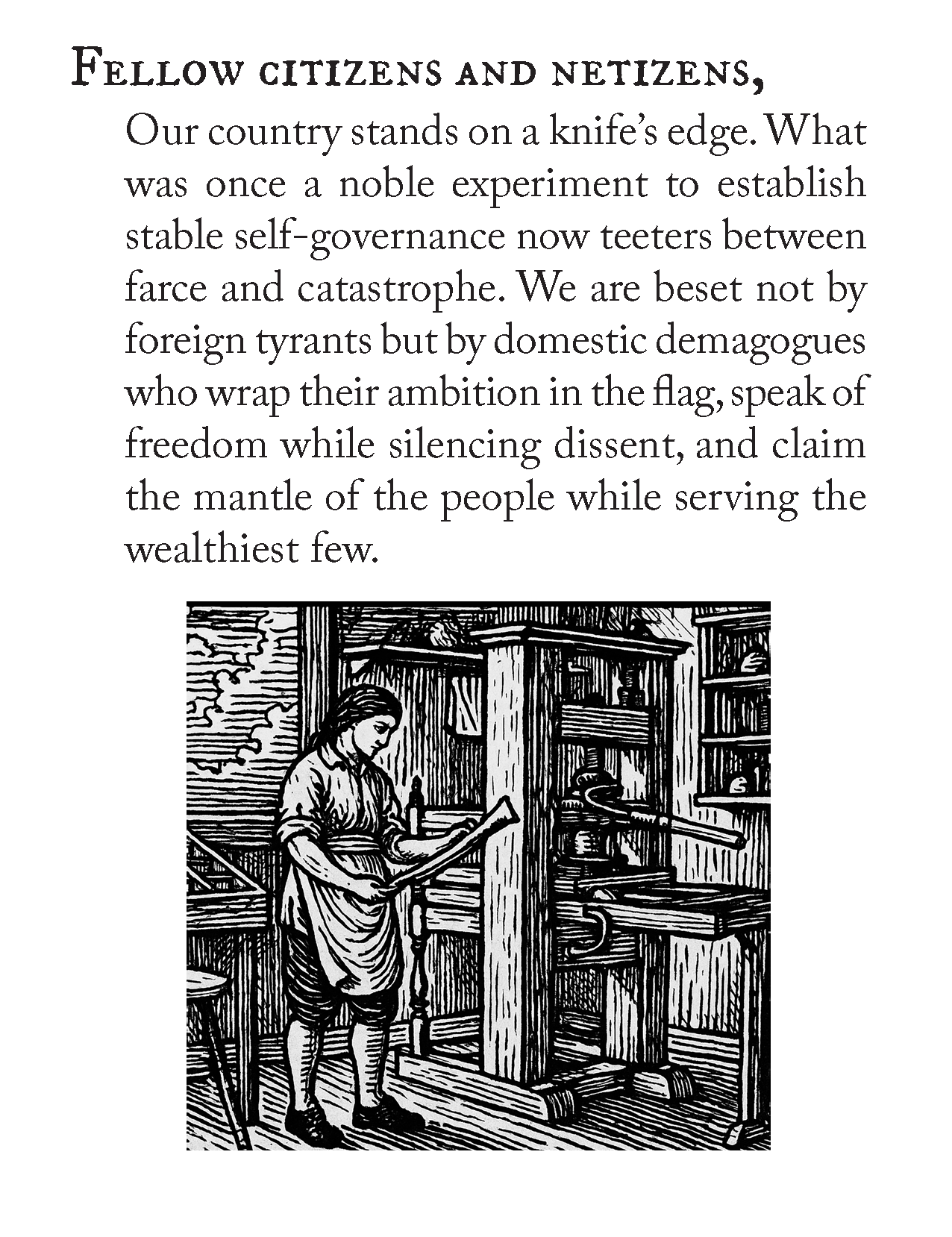
Fellow citizens and netizens,

Our country stands on a knife’s edge. What was once a noble experiment to establish stable self-governance now teeters between farce and catastrophe. We are beset not by foreign tyrants but by domestic demagogues who wrap their ambition in the flag, speak of freedom while silencing dissent, and claim the mantle of the people while serving the wealthiest few.

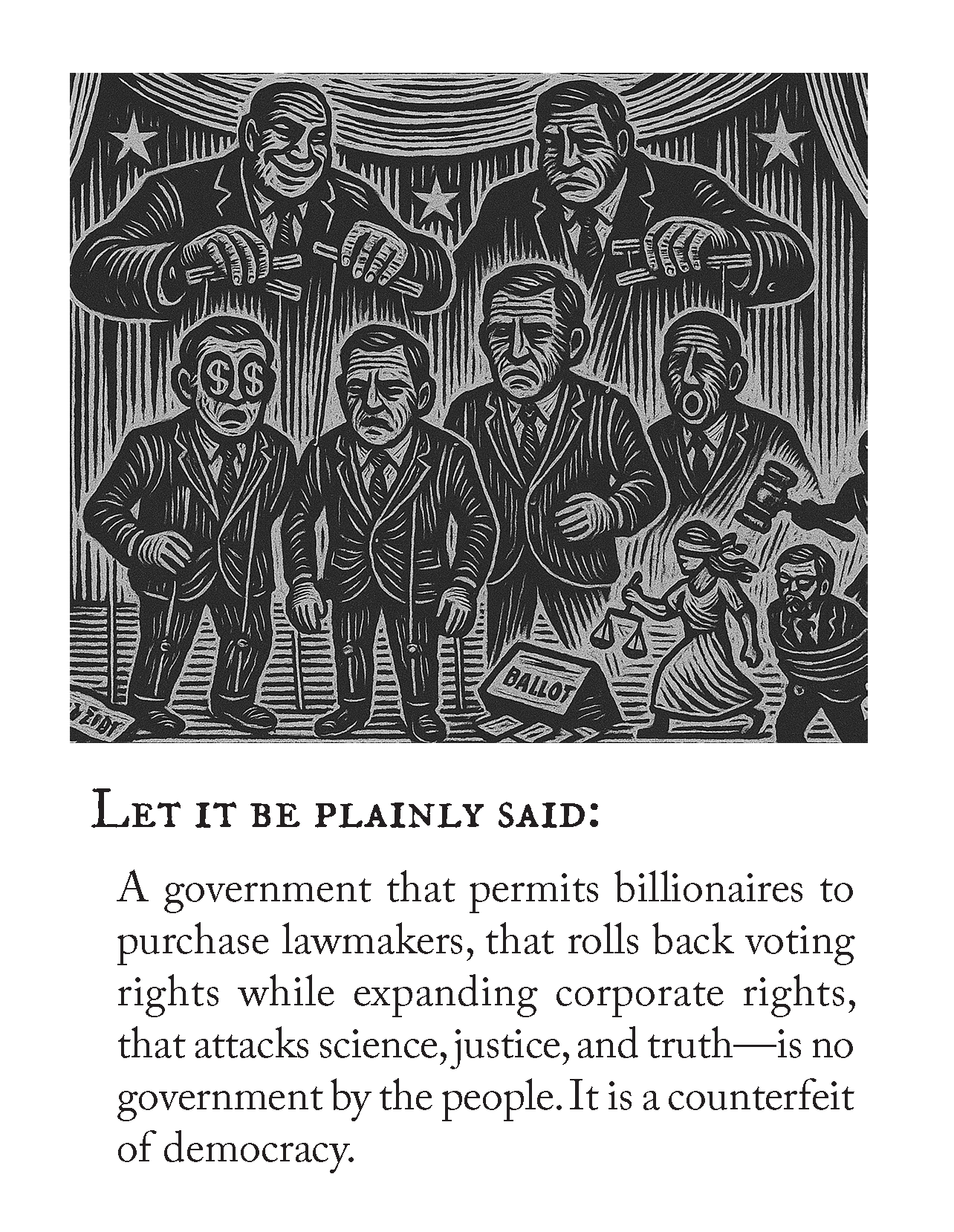
Let it be plainly said:

A government that permits billionaires to purchase lawmakers, that rolls back voting rights while expanding corporate rights, that attacks science, justice, and truth—is no government by the people. It is a counterfeit of democracy.

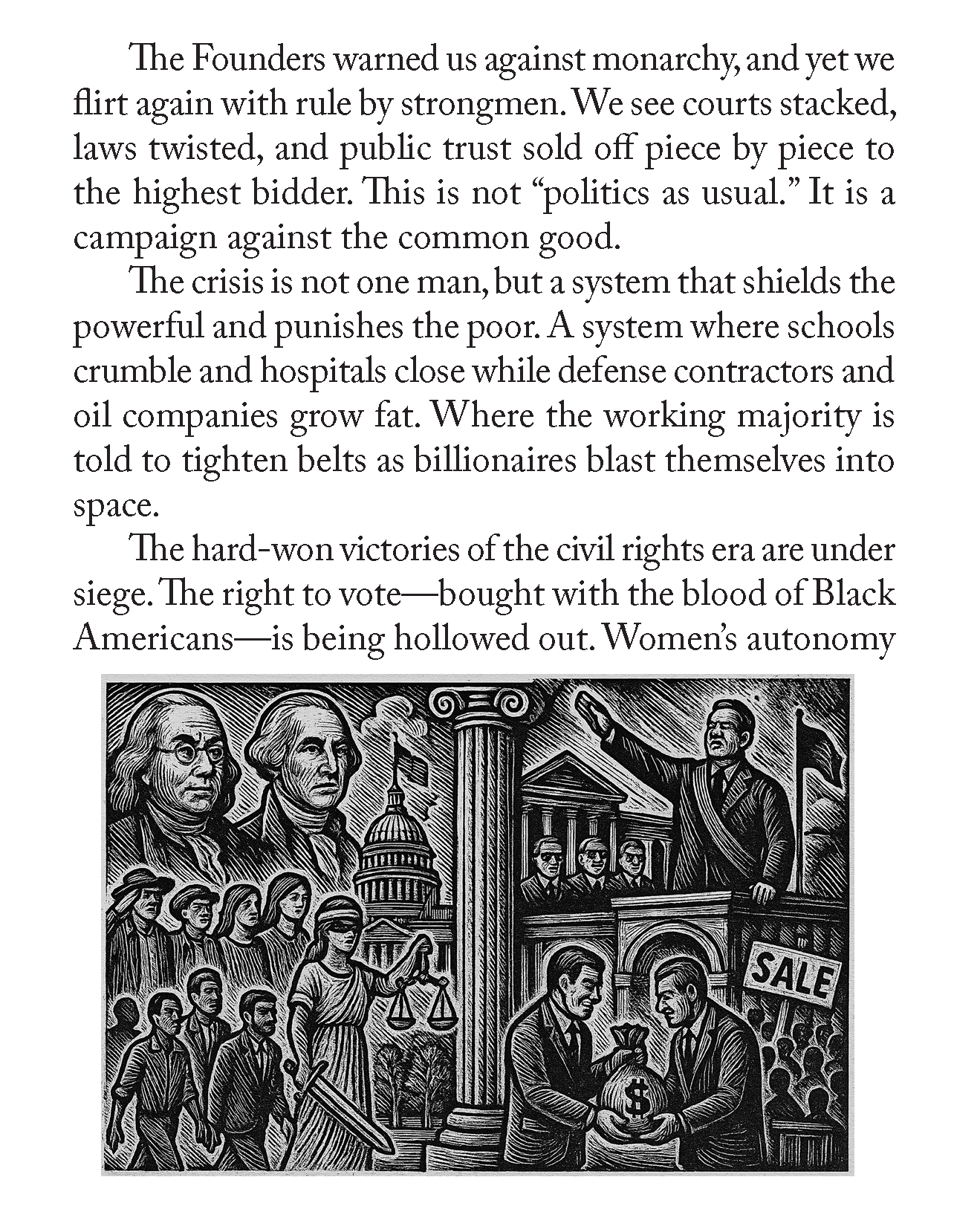
The Founders warned us against monarchy, and yet we flirt again with rule by strongmen. We see courts stacked, laws twisted, and public trust sold off piece by piece to the highest bidder. This is not “politics as usual.” It is a campaign against the common good.

The crisis is not one man, but a system that shields the powerful and punishes the poor. A system where schools crumble and hospitals close while defense contractors and oil companies grow fat. Where the working majority is told to tighten belts as billionaires blast themselves into space.

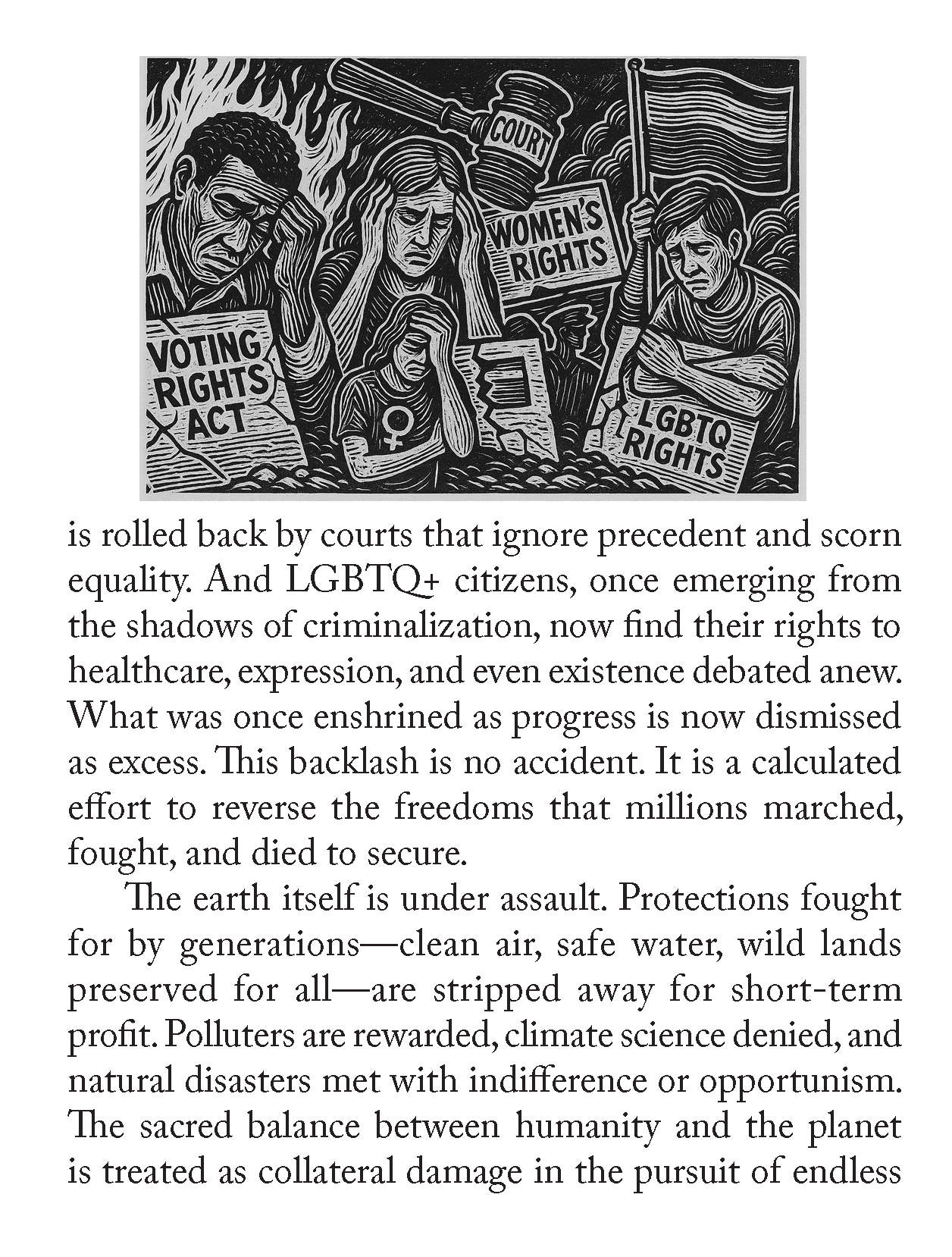
The hard-won victories of the civil rights era are under siege. The right to vote—bought with the blood of Black Americans—is being hollowed out. Women’s autonomy is rolled back by courts that ignore precedent and scorn equality. And LGBTQ+ citizens, once emerging from the shadows of criminalization, now find their rights to healthcare, expression, and even existence debated anew. What was once enshrined as progress is now dismissed as excess. This backlash is no accident. It is a calculated effort to reverse the freedoms that millions marched, fought, and died to secure.

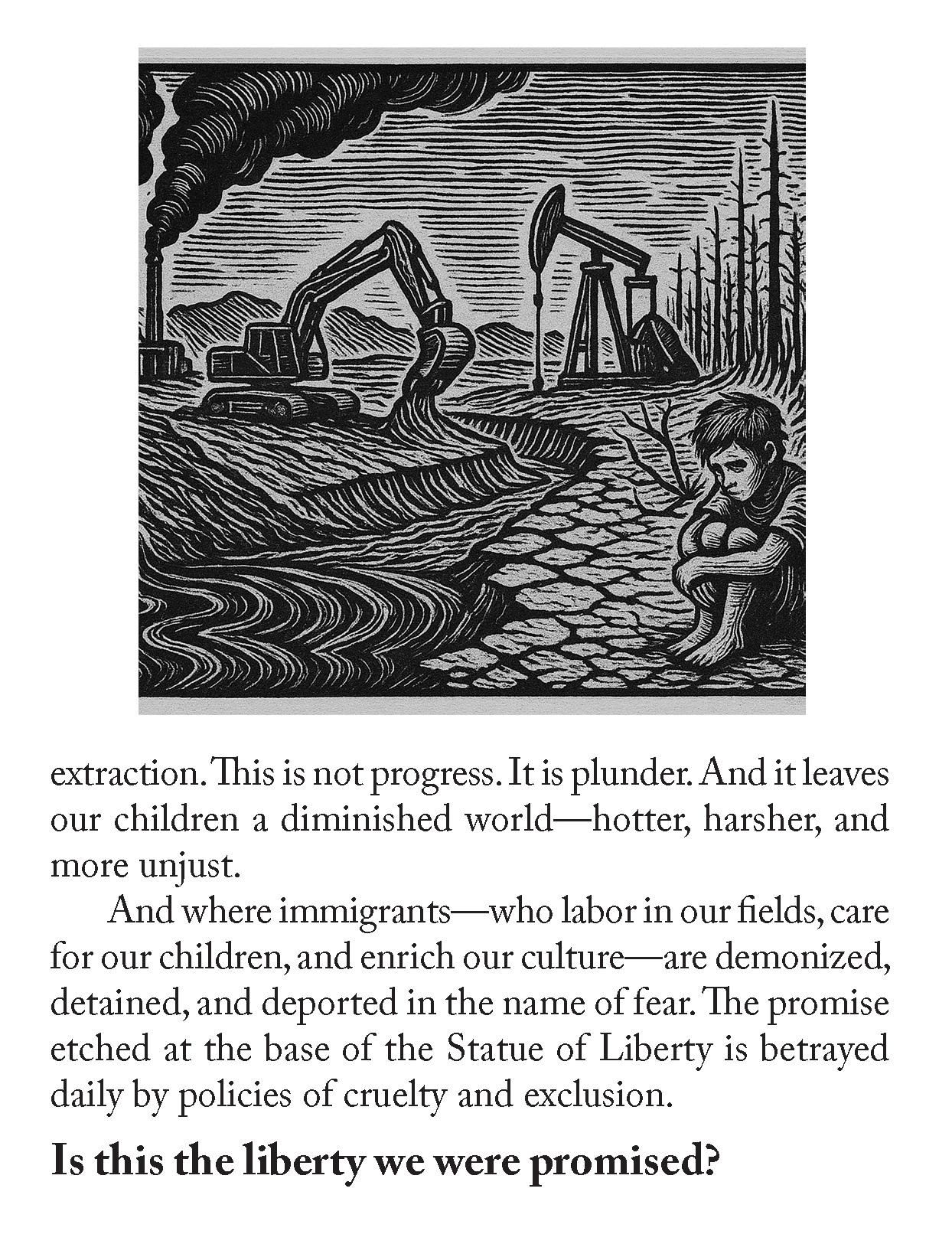
The earth itself is under assault. Protections fought for by generations—clean air, safe water, wild lands preserved for all—are stripped away for short-term profit. Polluters are rewarded, climate science denied, and natural disasters met with indifference or opportunism. The sacred balance between humanity and the planet is treated as collateral damage in the pursuit of endless extraction. This is not progress. It is plunder. And it leaves our children a diminished world—hotter, harsher, and more unjust.

And where immigrants—who labor in our fields, care for our children, and enrich our culture—are demonized, detained, and deported in the name of fear. The promise etched at the base of the Statue of Liberty is betrayed daily by policies of cruelty and exclusion.
Is this the liberty we were promised?

Let us return to first principles.

No monarchy.
No ruler above the law.
No government without the consent of the governed.
No justice denied because of wealth, race, gender, or belief.

We need not accept corruption as fate. We need not live under permanent emergency, culture war, or oligarchic rule. Power can be reclaimed. The soul of a nation is not for sale.

We must declare independence from cynicism. From fear. From lies. And affirm again our allegiance—to democracy, to community, to truth, and to one another.

Do not wait for saviors.

Be the revolution.

Join the movement to rebuild the Republic—free, fair, and for all.
Now is the time. Not later.

Not after the next election.

NOW.

“A long habit of not thinking a thing wrong gives it a superficial appearance of being right.”— Thomas Paine, Common Sense, 1776


Cover image: Thomas Paine, a corset maker from England, immigrated to Pennsylvania in 1774 at a moment of rising revolutionary fervor. His 1776 pamphlet Common Sense laid out a plainspoken argument against monarchy and for democratic self-rule. Published at a time of low morale, it became an instant sensation, electrifying the spirit of resistance that resulted in the Declaration of Independence six months later. By the end of the Revolutionary war, one in five Americans owned a copy of Paine’s catalytic essay.

Our Commons Are Free (#5)

Ben Kinmont arrived at my doorstep in 2022 asking to see the Digger archive. Ben is a project-based artist, and out of that first encounter emerged Our Commons Are Free. The initial iteration took place in a Santa Rosa park later that year, where Ben set up a Risograph—a stencil-based duplicator similar in spirit to the old Gestetner mimeograph machines used by the Communication Company and Free City—to print copies of A Short History of the San Francisco Diggers (and the movement they spawned) for anyone passing by.

Since that first production, Ben has taken Commons to Italy, to Paris, and most recently to the Wigan Festival in England. Now, this celebration of the Diggers is coming home. Beginning June 21, Fort Mason will host the latest iteration of the project. Ben has added new dimensions to the exposition, expanding its reach and resonance. Here is a link to the Fort Mason announcement.

Common Sense for the Current Generation

Peter Coyote posted a message on Facebook this morning that struck me with the same force as when I first read Thomas Paine’s Common Sense. For those who may have forgotten their American history, Common Sense was the spark that resulted in the Declaration of Independence six months later. (More about Paine and his pamphlet later—it sold 500,000 copies in a population of just 2.5 million.) But first, read Peter’s words. Share them far and wide. In this moment, Peter Coyote is Thomas Paine incarnate.

Quieting the Canaries (by Peter Coyote)

There are some spectacles, like staring into the sun that are so overwhelming they become destabilizing. They strip our sense of norms and proportion which might buttress any conventional reality. As a Zen priest who has meditated for over 50 years, my own mind and its projections, I would like to share my perceptions of this current moment as a source of  possible clarity.

An entire class of people, powerful because they are wealthy—conservative billionaires funding Christian Nationalists and other varieties of anti-democratic upheaval; tech billionaires who’ve concluded their mathematical talents should exempt them from social responsibilities and any consequences for the feral and deliberately addictive Social media they’ve unleashed on the Nation. This list would include C-suite Executives so fixated on share price, corporate bottom lines and bonuses, that the disintegration of our National life is collateral damage.

This cabal has concluded they’ve reached the zenith of their possibilities and would like to freeze their advantages where they are. They have successfully strategized how to loot the Nation of every form of its wealth, simultaneously exempting themselves from every social and legal responsibility to the majority of its citizens.

There is no other way to appreciate the self-benefit they’ve designed into the current Republican Administration budget—its tax-cuts for them alone, imposing on every citizen, business, and national event, the exorbitant interest costs of a $9 Trillion dollar National debt (about a Trillion a year). It’s an inconceivably large number. A thousand seconds is about 16 minutes. A trillion seconds is 32,000 years. 1,000 pennies would fit in a small jar. A trillion pennies would make a cube the size of a football field. $9 Billion dollars represents nearly 30% of our entire 2025 GDP of  $30.34 Trillion. It’s an amount larger than our current military budget and will constrict economic possibilities and policies, public investment for research, innovation, public health services, Medicare and Social Security for generations.

The current abandoning of medical and scientific research, once among America’s greatest contribution to the world: the cancellation of aid, food and medicine to the world’s poorest people, the decision to end the global detection and cure of pandemics for our own early warning, the refusal to acknowledge climate crisis or diminish the amount of oil, diesel and jet fuel that we burn, or to acknowledge our failures to protect our citizens of color and non-standard gender definitions from vastly unequal treatment is a public announcement by bullhorn from this class to the rest of us, that their value system includes nothing but their personal empowerment beyond which nothing is worth a moment of their consideration.

This is an entire class of people, the real enablers of the Trump Republican agenda. It includes every Republican official, State, Local or National who have surrendered their Constitutional right to legislate and control the spending of our revenues. They deny the Constitutional birthright of Congress itself and in this regard are equally culpable to the mob that invaded the Capitol on January 6th.

Stories of brazen arrests and attacks on public officials advertise over mass media which people do and do not count to them, which ones are exempt from regulation and law and which are not. In the face of this daily insult to our body Politic, our news media takes delusional cheer celebrating unenforceable Court decisions, convincing ourselves that we are not in a “crisis” because “the judges are on our side.” This is the self-delusionary myopia that lulled thousands of Americans to their deaths and spilled our blood and treasure into the dirt, sand, and rice paddies of Vietnam, Syria, Iraq and Afghanistan.

TV rakes in ad revenues from describing the chaos as the entire Nation is dismantled in front us by this lawless class, supported by a majority on the Supreme Court, whose flagrant public corruption would embarrass a hypocritical tele-evangelist.

The political class has sat idly by for decades allowing money unrestrained rule over our every political and cultural institution. They have pawned our public airwaves off to the corporate sector and the public never noticed it. Until we begin serious deliberations to curtail that power—Universal or Mandatory voting, prohibition of corporate contributions to politics, fully funded National elections—we will do nothing but continue to witness and chitter about the catastrophe amongst ourselves, like pet canaries, at day’s end as the night cloth is draped over the cage, stilling our song.

—Peter Coyote (May 13, 2025)

Robert Young’s Eulogy for Peter Berg

Recently, I was able to locate the video of Peter Berg’s memorial in 2011. The event took place in the spacious auditorium of the Randall Museum, on Corona Heights near the tip-top of that rocky outcrop that overlooks the expanse of San Francisco at its feet. This is the very location where many of us had welcomed winter solstices in years past. Peter with his conch shell welcoming the sunrise would always be a memory frozen in time.

There were hundreds of souls who showed up to honor Peter’s memory on October 1, 2011. There were bouquets of herbs, flowers, totems, instruments and offerings on the altar at the front of the stage. Someone had prepared a listing of the dozens who had volunteered to speak. Rob (as he was introduced) was near the last. Here are his words. Ever since hearing Rob talk about what he saw as Peter’s contribution to anarchist theory, I had wanted to find the video and get the transcription entered into the historical record. At last, it is done.

Rob Young’s Eulogy at Peter Berg’s Memorial, October 1, 2011

When you guys were doing your thing in San Francisco there were a bunch of us, 200 million of us, that were elsewhere, living in a faraway country called the United States of America. We were growing up good and proud and watching John Wayne, and when I delivered the newspapers, I used to report the latest American victories on the Vietnam fronts to my clients. And then one summer, I was up in Canada at the family cottage, and in the cottage there was a pile of battered old paperbacks with the front covers torn off. And there was one in the stack. I was about 14 or 15 years old, and it was called Notes from the New Underground. And there were some Digger essays in this thing. So, I read them, and they made so much sense to me that I thought I need to leave the country I’m in right now — not being Canada — United States of America and find these people who have written this stuff and learn more from them about that.

And many years passed and through the inevitable circuitous route by which all of you came to be connected with these people, I, too, followed that circuitous route and came to work at Planet Drum for a while. And while I was there, I was going through the mid-20s, tumultuous, horrific period of life, right? There’s three of those. There’s the terrible twos, and then there’s the terrible 20s, and there’s some other thing I haven’t experienced yet, but later in life that some of you know, and I don’t know. (Voice from the audience says, “menopause.”) Menopause. Thank you. Now I have a word for it, and it was a very difficult time for me at Planet Drum. I was trying to work there and trying to sort some stuff out. And one day, Peter and I were walking down the street together, and as we’re walking down the street, I was thinking about how my dad and I used to walk down the street, we’d hold hands. I was ruminating on this, and suddenly Peter just stops and looks at me like he has that sort of “Owl-Hawk” look thing that he does, you know, and he says, “What?” “You want to hold hands with me, or something?”  It’s like holy shit!  And so that’s when I knew he was really something special.

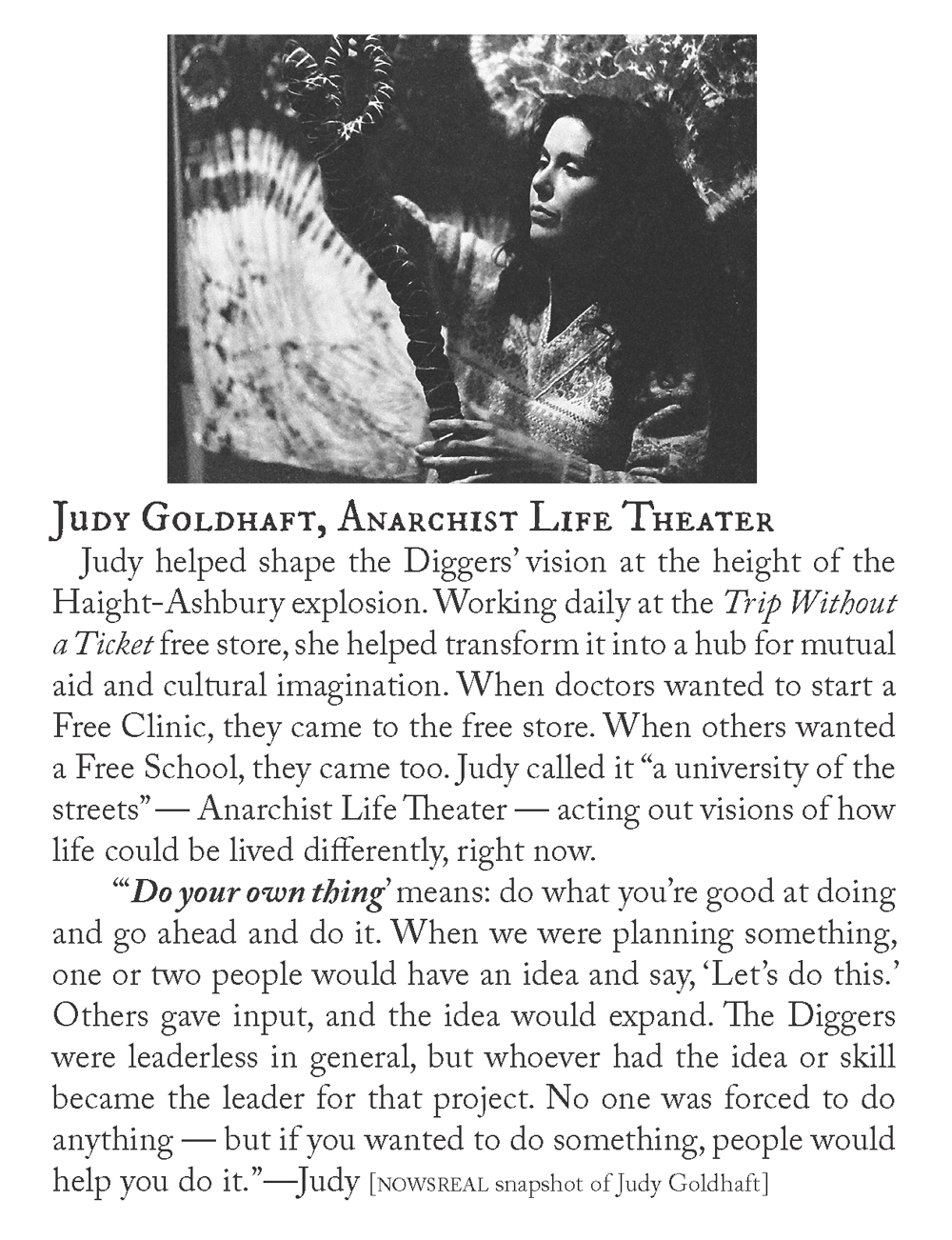
So, he was all about location, you know, where are you and what is home, and where are you? And is your head up your ass, or is in the watershed somewhere? And I want to locate Peter for a second, world historically, right? Because a lot of interesting people … as a person said tonight, this is a high character environment for me tonight, looking at all of you. I want to locate Peter in world historic terms. Peter Berg for whatever all the things he was and is, made a very significant contribution to anarchist thought. Anarchist thought up until that point, things like “Anarchist Communism,” by Kropotkin, Bakunin’s theories and Max Sterner’s individualist anarchism, all that stuff. They always talked about the social structures that were necessary for a liberated society, and they elaborate on them in different ways, but they remained modernist theories, because they were social structures that could zip around the planet and sort of be anywhere. You could have this social structure in Bulgaria, you could step over here to England, and it was nowhere. And then Peter Berg came along and answered two important questions in anarchist theory. Where do you locate those social structures? In the bioregion. And secondly, who is the constituency for those social structures? And that’s all species. And Berg made those two contributions. He has radically advanced and matured anarchist thought by those contributions, no doubt heavily influenced by another very important anarchist, Judy Goldhaft. [Audience acclamation.] So, when he said, “What do you want to do, hold hands?” like I wasn’t sure if he wanted to — that’s my personal thing about his magical stuff. But the other thing is his contribution to anarchist doctrine in the world.

And the last thing I want to tell you is, in July of this year, I was walking through some fields, I live in Eugene, and I was walking with my six-year-old daughter and my four-year-old son, and up above us, three military planes were flying, jets, fighters ripping across the sky. And I looked up and I said, they’re flying in the missing man formation. And my son and daughter said, “What do you mean? What’s the missing man formation?” I said, “Well, when somebody who’s very important dies, the United States Air Force will do a flyover in the missing man formation.” And they said, “Where are they going?” And I said, “Looks like they’re going south. They’re headed toward San Francisco” and I didn’t have the word yet, and my six year old daughter said, “Clearly someone very important has just died in San Francisco.” And the next day, I got a call from Judy. So, even the United States Air Force is compelled by the magic of Peter Berg to honor one of their fellow men in arms when he passed away. Peter, you’re so fucking present, I want you to go someplace else for a little while, because you’re filling up the room. Thank you very much for what you’ve done.

[Transcribed by Judy Goldhaft, Eric Noble, with machine assistance, 26 Sept 2024]

Rob died in 2018. Here’s an obituary.

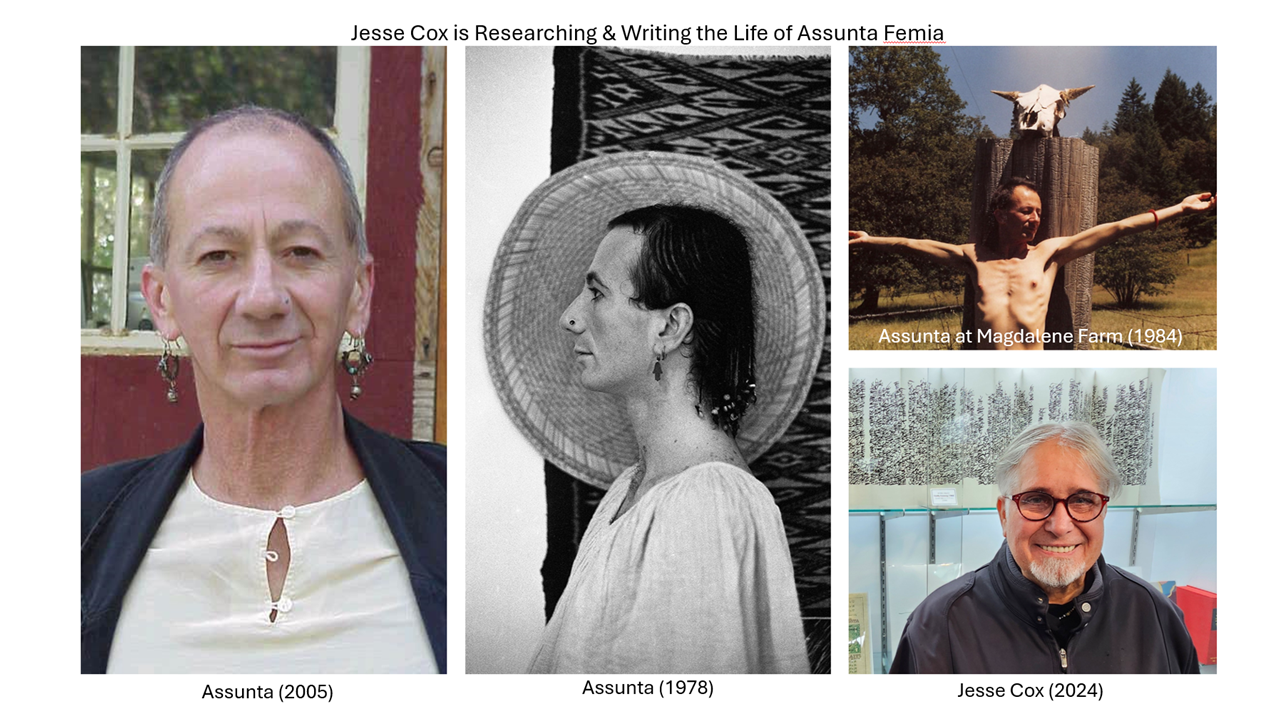
Jesse Cox is Researching & Writing the Life of Assunta Femia

Many of you have contributed to previous GoFundMe projects of The Digger Archives. This is another fundraising plea to help preserve our tribe’s history. Jesse Cox is a people’s historian of the most authentic variety. Jesse’s writings are a cross between a geographer’s intimate association with the landscape and the be-bop prosy of a Jack Kerouac. We hope to eventually share his stories of our communal past, stories of one of the first communes on Castro Street, stories of the Hearthshire Community in northern California, and — the aim of this GoFundMe — the stories of Assunta Femia, the progenitor of a transgressive gay feminine spirituality.

Jesse is 72 years old and he is struggling with the age-old dilemmas of physical and economic limitations. Jesse still is moonlighting gigs while pursuing a passion for finishing his deep history of Assunta, once Jesse’s love and guiding spirit. Assunta was both shaman and prophetess. Her legacy must be preserved and Jesse is the best person to do it. Read the memorial that Arthur Evans wrote after Assunta’s passing in 2006.

There will be much more shared in the coming days and weeks as we grow this fund. Jesse has his fingers in many pies but Assunta is top of the list.

Thank you, all and everyone!

Here’s the full GoFundMe link: https://bit.ly/GoFundMe-for-Jesse

Comments on the Long Lost Interview of Arthur Lisch

Recently, I was able to digitize the interviews that Alice Gaillard and Céline Deransart conducted in 1998 in the making of the documentary Les Diggers de San Francisco. Among the dozens of people Alice and Céline interviewed was Arthur Lisch, one of the early San Francisco Diggers who played an important role, especially in his contacts with the liberal religious community in San Francisco. Arthur can be seen in several of William Gedney‘s photos from the first weeks of the Digger Feeds and the Digger Free Frame of Reference free stores. The interview of Arthur did not make it into the final cut of Alice’s and Celine’s film, so its recent discovery is all that more valuable and remarkable.

I say remarkable because there are things in the interview which have shined light on aspects of Digger history that have remained murky until now. Above all, Arthur demonstrates the influence of the original Diggers of 1649 in Surrey, England. Over the years, I’ve heard people say that the English Diggers played a minor influence on their latter-day namesakes. Reading Arthur’s interview will prove that suggestion false. Gerrard Winstanley’s True Leveller (Digger) writings from 1649+ obviously had an immense effect. Up until now, it has only been Emmett Grogan’s account in Ringolevio, along with several of the ephemeral statements in Communication Company street sheets, that testified to this influence. Now, we can see in Arthur’s words, how completely the English Digger ideas were understood and transplanted into the 1960s counterculture. Here is an excerpt from Arthur’s interview, describing the living circle he had inscribed on the earth in the midst of a public park thirty years after the Summer of Love:

“The circle is a latter day initiative that has to do with the Digger philosophy — not just the Digger philosophy, but the original ‘True Leveller’ philosophy. The True Leveller philosophy was even further called the Christ Levellers. And the idea of the True Levellers was that the common land belongs to the common people who choose to come on that land, care for the land, love the land, work the land. So in the sense that the initiative was taken by me 10 years ago, to establish this circle, this is, 30 years later, a Digger initiative — this is a True Leveller initiative. It is, because I say it is [chuckles], and because that’s my intention. It’s a spiritual scientific experiment: to see if a circle is drawn on the earth, if people will come, and if they will fill that circle with care, concern, love, work — activity.”

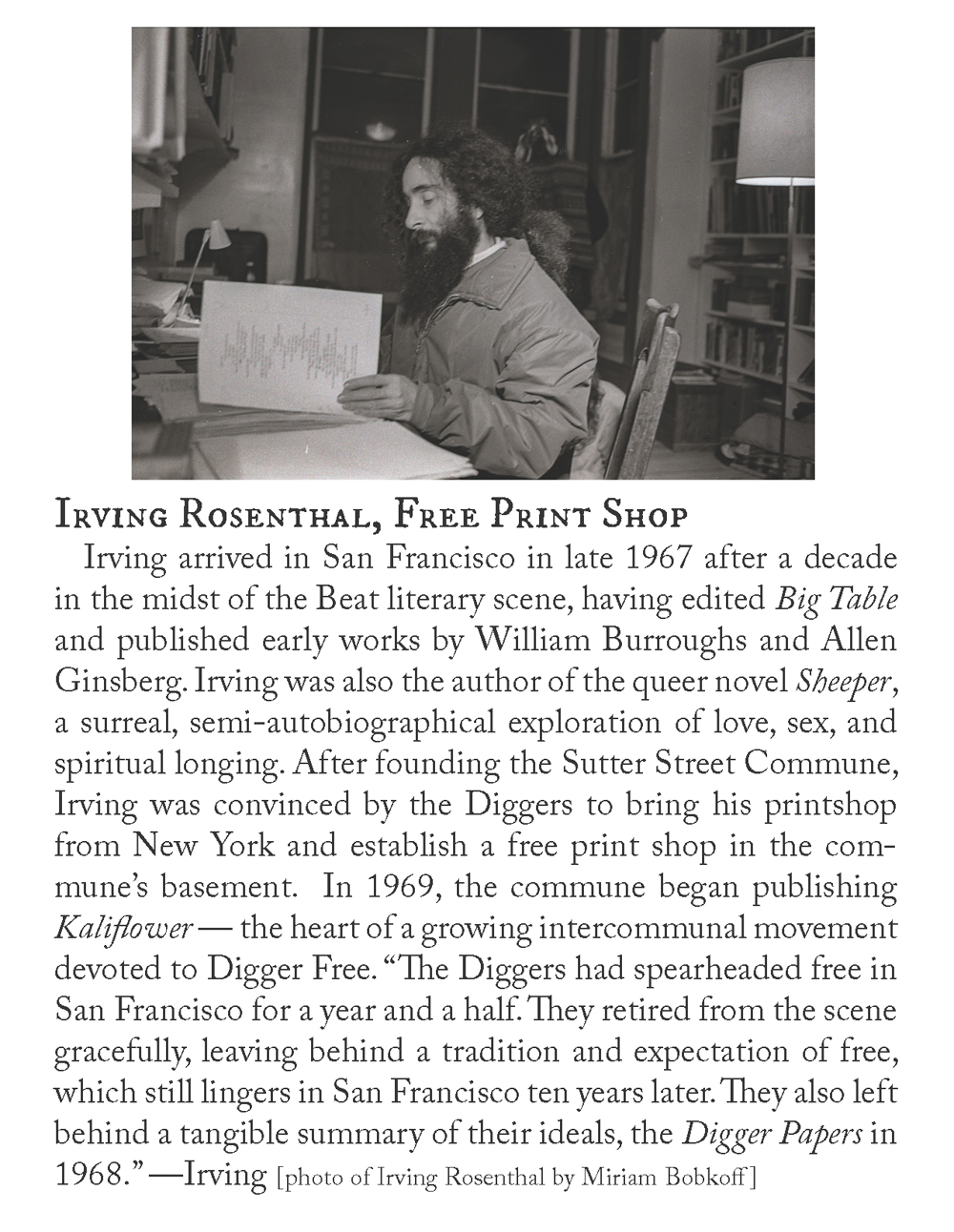
We can see from this activity that Arthur was creating a vision of the original English Digger notion of the Earth as a Common Treasury for all. Arthur had read and understood Gerrard Winstanley’s writings so completely that he was on a lifelong mission to encapsulate those ideas. He also had obviously read about that period of English history known as the English Civil War because, later in the interview, he talks about the common origins of the Quakers and the Diggers at that time. I think this interview is strong evidence that the influence of the English Diggers on their twentieth-century namesakes was profound. Up until now, Emmett Grogan had been the prime example. Now we can see that Arthur Lisch is another. (Still another example is that of Irving Rosenthal, founder of the Sutter Street (Kaliflower) Commune, but his ‘conversion‘ to Digger philosophy happened two years later.)

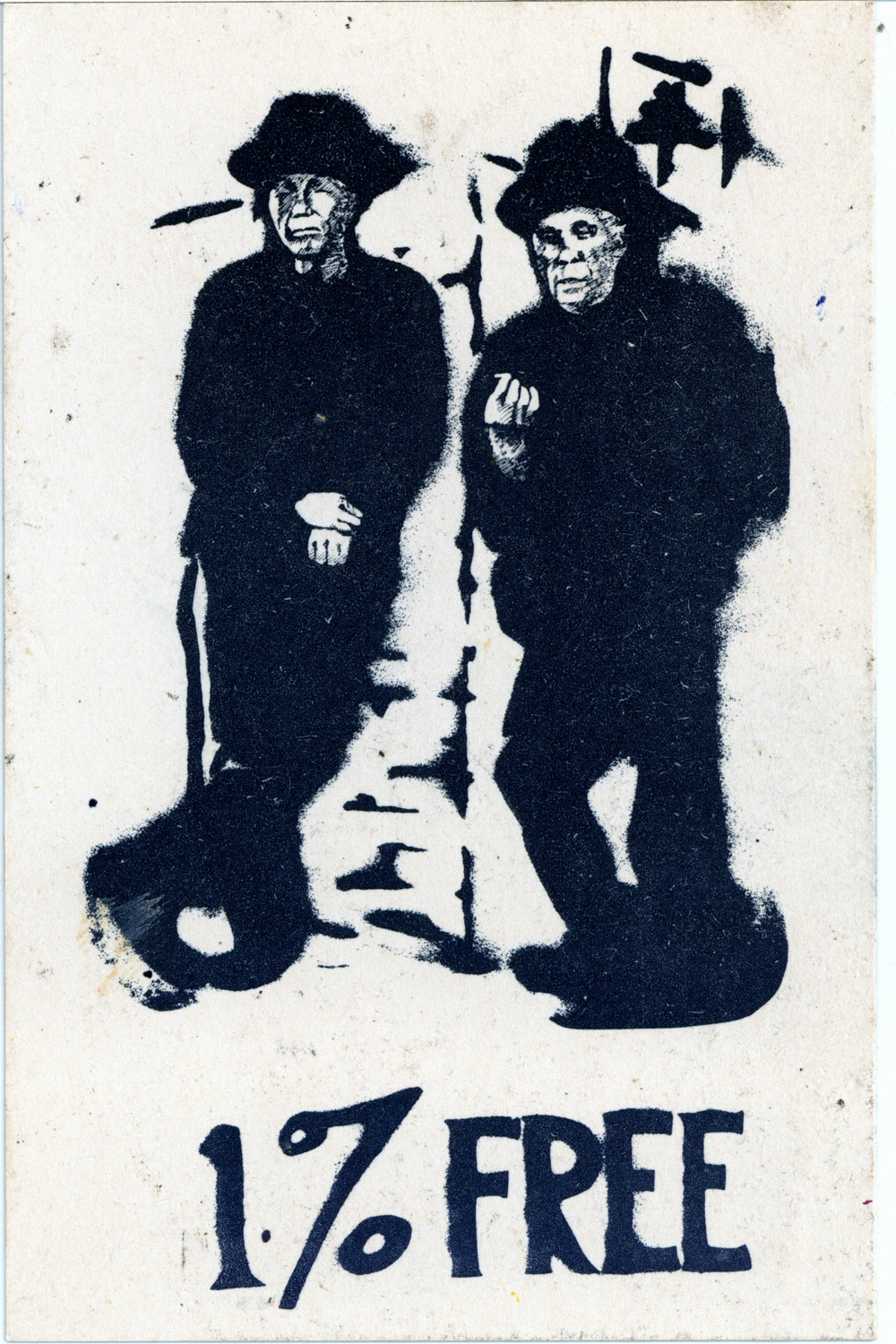
Arthur relates his work on the Earth Circle to the poster that the Diggers produced in the Winter of 1968 with the image of two Tong warriors standing on a street corner and the only text on the poster being the I Ching character for the hexagram “Revolution” and the words 1% Free. Ever since this poster appeared mysteriously overnight on walls and surfaces scattered around San Francisco, people were left scratching their heads wondering at its meaning. Peter Berg described the effect of this, what some considered menacing, image. In one of his interviews, Berg said, “The … merchants thought it was a profiteering scheme. They thought 1% Free meant we were the mafia. We’d beat them up if they didn’t give it to us [laughter].” Arthur Lisch describes his own take on 1% Free:

“[T]he initial beginning [of the Earth Circle] goes back to that poster that was made that said ‘1% Free’ … [T]he idea of being “1% free” means that, to me, we can take that initiative, we can take that step, and then things will fall into place around it. This was initially 1% free. It’s not 100% free now, but so many people have come here, worked here, care for the place, they’ve claimed this circle of land in the name of community and the name of the sacred in life, in the name of a higher way of being. … In other words, to see the higher in each other, for each of us to see what is better, what is hopeful, what is possible in each other. And this small circle is dedicated to that.”

Another important piece of the interview of Arthur is something he mentions in relation to Emmett Grogan. “I remember Emmett Grogan writing ‘The Ideology of Failure.’ I think he mentioned me in a little essay about going out to Hunter’s Point in San Francisco, with a sculpture that was installed there where a 14-year-old was shot running across the field by the police. And I went out there every day for a number of months to vigil and to meet with people and to try to make a park, back in 1967. And Emmett mentioned that, and the idea that you need to be anonymous, you need to be not prideful about your work, you just need to offer your work and your activity.”

“The Ideology of Failure” appeared in the Berkeley Barb in November, 1966, a month after Emmett and Billy Murcott began bringing hot stew to the Panhandle for daily free feeds. The article was signed “George Metesky” and it was the second article about the Diggers that was signed thus. George Metesky, of course, was a pseudonym (the real George Metesky was serving a sentence for the bombings he had carried out over a sixteen-year span in New York where he had been dubbed the “Mad Bomber” by local newspapers).

Over the years, I have tried to determine who wrote the early Digger articles that were signed pseudonymously, specifically “The Ideology of Failure” which is a crucial and foundational text for understanding the Diggers. There has never been a clear-cut answer until now. Emmett Grogan was the natural and logical choice (many clues in Ringolevio, not just to his fascination with the Mad Bomber, but key words and phrases he used). But others were proposed as the author — Peter Berg, Peter Coyote, a collaboration between Emmett and Billy, even one very serious suggestion that it was Abbie Hoffman. With this interview of Arthur, the balance has tipped. Emmett Grogan was the author of this piece and most likely of all the Digger “George Metesky” articles.

This whole line of speculation brings up a topic that is close to my heart. Anonymity. The Diggers maintained (at least at the outset) a cloak of anonymity and protecting that veil was one of the games they played with their audience. The famous story of the two reporters attempting to interview the “manager” of the Trip Without A Ticket is an example. Both reporters arrived independently at the free store. The Diggers took each reporter aside and swore each to discretion if they wanted to interview the manager who did not want to acknowledge himself as such. Then the Diggers introduced the two reporters who interviewed each other for some minutes before realizing the caper.

For historians, the question is to what extent we should honor the veil of anonymity or pierce it. Half a century after the events in question, I think there are valid historical reasons to pierce the veil.

People’s Red Dragon Architecture

This 8-1/2″ x 11″ page was designed by the People’s Red Dragon Architecture collective and published by the Free Print Shop in an issue of Kaliflower, vol. 3, no. 22, September 30, 1971.

“One of my fondest hopes is that we are all learning to share ideas. More and more people are coming to speak with one voice.

“We have come to the point where we all can put our ideas on one page. I hope to see the time when all the people in a group can entrust their thoughts to one pen-hand.

“EVEN people who all live together have not all reached this point as you can see by the different hand on this page. But we do share some things.

“WE all share in what is accomplished through effort and discipline. We all have a certain commitment to the community in which we live.

“MAO says, ‘We are confronted by two types of social contradictions — those between ourselves & the enemy and those among the people themselves. The two are totally different in their nature.’

“PEOPLE must hold together to gain an understanding of what we are alive for. People can visit each other and talk on the phone.

“ANYTHING that reaches more than fifty people is propaganda. If all the folks who get the message have a part in making it up, it’s people’s propaganda, which is GROOVY.”

Fred Moore: Trust in People

Fred Moore died in a horrendous car accident in 1997, much too young for such a committed activist and pathfinder. Fred carried out one of the (if not the) first of many anti-military protests on the campus of the University of California at Berkeley. In 1959 at the age of 18, Fred sat-in on the steps of Sproul Hall to begin a fast protesting mandatory ROTC training for all entering male students. Future activists who led the Free Speech Movement credit Fred’s act in 1959 as the opening round of the Sixties student protest movements.

As much as Fred’s career as a lifelong pacifist, non-violence advocate, continental walker for peace and justice, and devoted father deserves a clarion call of remembrance, that is not my purpose with this posting. Instead, I want to call attention to Fred’s connection with the Diggers and the philosophy of Free. Fred played an important role in proselytizing the vision of a society free of buying and selling, just as the original English Diggers (1649) and the San Francisco Diggers (1966) had done. Fred also was instrumental in my uncovering a forgotten piece of Digger history.

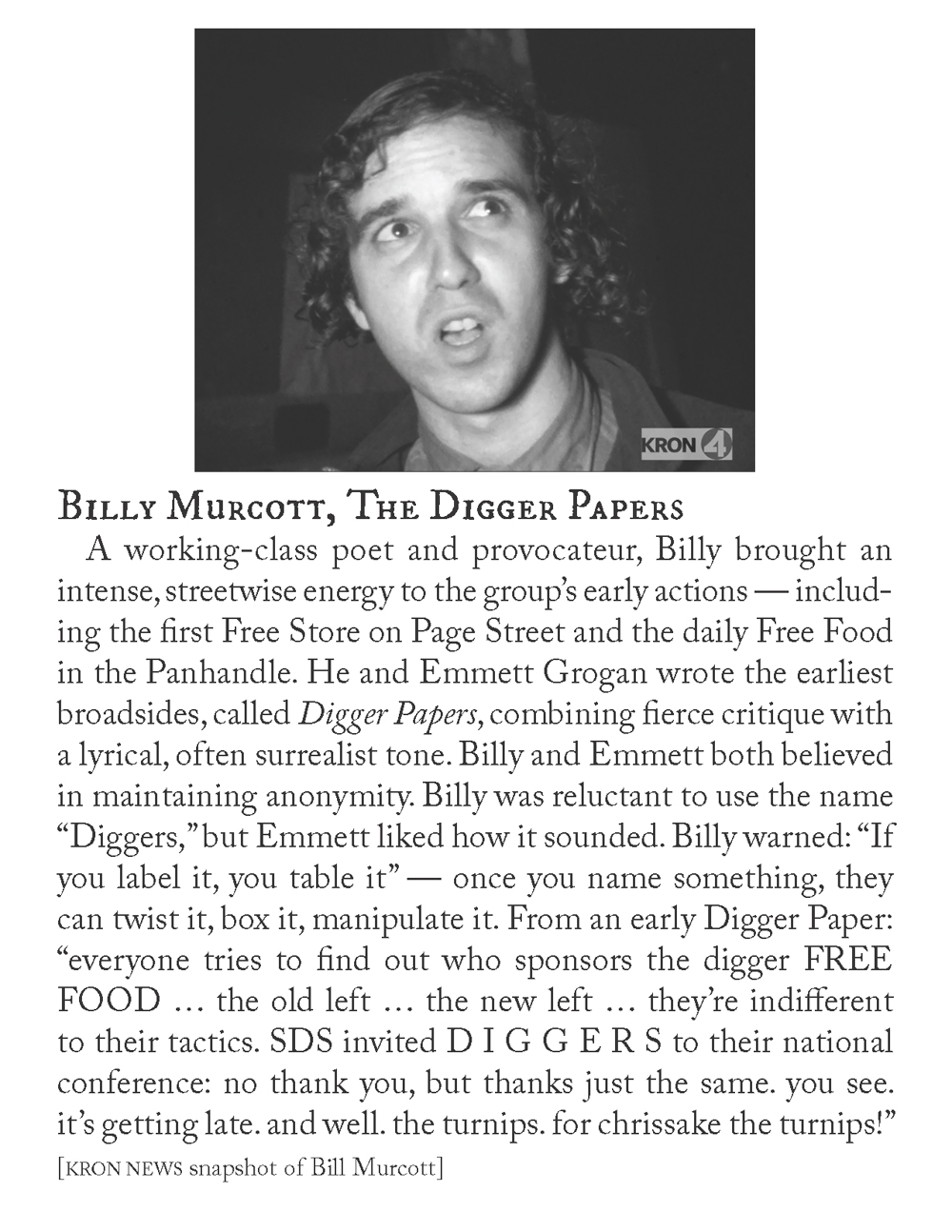
First, the uncovering story. In 1974, I had been living in the Kaliflower Commune for three years and had started collecting the leftover remains from the Digger movement that had burst onto the scene in 1966 and finally dissipated (at least in the public eye) in 1968 (or thereabouts). We were actively collecting Digger Papers, Communication Company broadsides, Free City News sheets and posters. We had reached out to all manner of folks — Ron Thelin, Peter Berg, Judy Goldhaft, Peter Coyote, Eileen Ewing, Linn (Freeman) House, Vicki Pollack, Siena Riffia, Phyllis Wilner, Allen Cohen … etc. We were begging, and borrowing whatever we could turn up for the Digger collection. We were also interviewing folks. Tape recorders made people nervous so I would write up notes and type a “memcon” when I got back to the commune. The term memcon came from the Watergate hearings, which Irving was avidly watching every day on a black-and-white TV he had bought cheap at one of the used furniture stores in the Western Addition.

I would reach out to total strangers and ask if they had any Digger materials they could share or let us borrow to make Xerox copies. In January 1974, I contacted Fred Moore. I wrote to him at the address in Menlo Park where he was coordinating something called the Information Network. (More about it later…) Fred responded and we had a phone call the following month. Fred said that the only person he knew who had been involved in the Digger movement was a man named Walt Reynolds who had taught the Diggers how to bake bread in coffee cans. Fred had met Walt at Resurrection City in Washington, D.C., in 1968 (the last project that Martin Luther King had planned before his assassination). After our phone call, I contacted Walt and he told me his story. Here is the memcon I wrote at the time about my phone call with Fred and then with Walt: (to view any of the images, click and choose open in new tab)

Fred’s introduction of Walt Reynolds uncovered a whole piece of Digger history that had not been documented. The result was the page on the history of Digger Bread and the Free Bakery(ies).

But wait, there’s more. Fred may have contributed this significant piece of history to the Digger story. But even more importantly, he was an influence on the budding personal computer revolution in the early 1970s. Fred was involved with Lee Felsenstein and the Community Memory project that created the first online computer switchboard (later termed bulletin board). And in 1974, Fred started a project in Menlo Park called the Information Network that was his vision of a society without buying or selling. The following year, Fred and Gordon French put out a call for a group of computer enthusiasts to come together and share ideas, inventions, and technology. This became the Homebrew Computer Club. Much has been written about this moment when some of the long-haired underground computer hobbyists first began experimenting with the new Intel and Motorola microprocessor chips.

Fred’s role in the Homebrew Computer Club has been widely recognized. See, for example, Walter Isaacson’s biography of Steve Jobs. Or John Markoff’s What the Dormouse Said: How the 60s Counterculture Shaped the Personal Computer Industry. Or Steven Levy’s Hackers: Heroes of the Computer Revolution. Or Fred Turner’s From Counterculture to Cyberculture: Stewart Brand, the Whole Earth Network, and the Rise of Digital Utopianism.

All of those (and more) sources are replete with the influence that Fred had. But none of them totally explain his philosophy. That’s where this last piece of the puzzle is so crucial. At some point, Fred visited Joseph and me after we had moved out of the commune, and he gave me a document that I think is the missing link between the Diggers and Fred’s inspiration that can be seen in the open source and free software movements. Recently, in our ex-commune member Zoom group, we got to talking about Fred. I pulled out the copy of Fred’s manifesto that he had donated to the Digger archive. It was printed on newsprint but I scanned it several years ago. Nevertheless, both in the hard copy and the scanned version, it is not an easy document to read. The printing is tiny, quite dense. So, I decided for the sake of our Zoom group to transcribe the text. The title of Fred’s vision is “Put Your Trust in People, Not Money” and it lays out the philosophy that is still practiced today in many corners of the World Wide Web. Here it is: