Fifty years ago, the Diggers proclaimed a Free City in San Francisco. This year, City College proclaimed a new Free City open to all San Francisco residents.
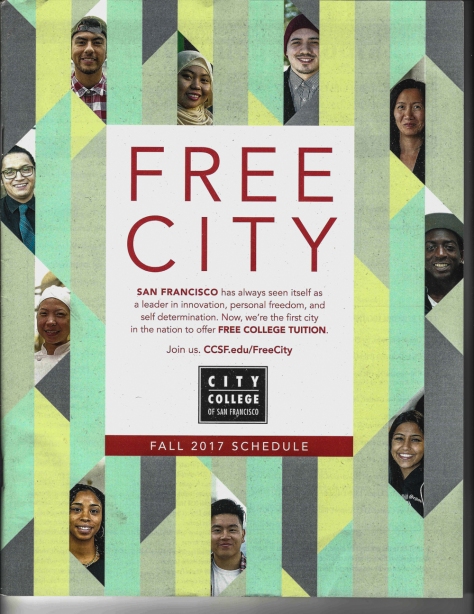

Fifty years ago, the Diggers proclaimed a Free City in San Francisco. This year, City College proclaimed a new Free City open to all San Francisco residents.
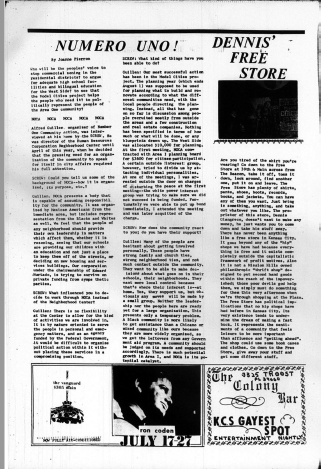
Here’s an article I found in The Screw, an underground newspaper from Kansas City, MO (Aug. 1, 1969):
Are you tired of the shirt you’re wearing? Go down to the Free Store at 39th & Main across from The Beacon, take it off, toss it down, look around, find another one, put it on and leave. The Free Store has plenty of shirts, pants, shoes, boots, records, books, and jackets. You can have any of them you want. Just bring in something, anything, and take out whatever you like. The proprietor of this store, Dennis Giangreco, doesn’t want to make any money, he just wants you to come down and take his stuff away. There has never been anything like a free store in Kansas City. It goes beyond any of the “hip” shops we have had because everything is free and it exists completely outside the capitalistic framework of profit motives. Also it is not a Mission Hills owned philanthropic “thrift shop” designed to put second hand goods within the reach of the impoverished; those poor devils god help them, we simply must do something for them this very afternoon when we’re through shopping at the Plaza. The Free Store has political implications that no hip shops have had before in Kansas City. Its very existence tends to undermine the dream of making a fast buck. It represents the sentiments of a community that feels leisure to be more important than affluence and “getting ahead”. The shop could use some book cases and clothes. Go down to the Free Store, give away your stuff and get some different stuff.
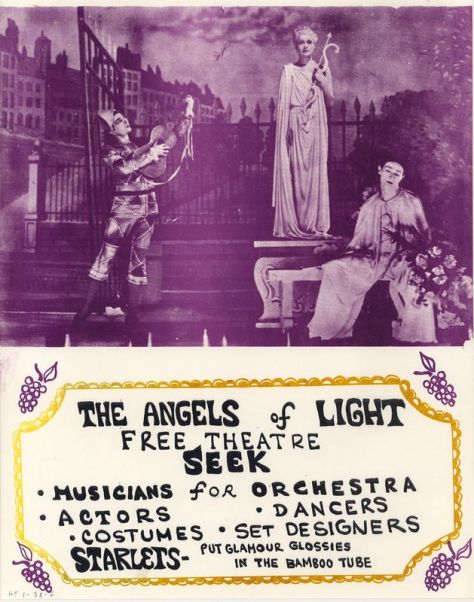
This past week saw visits by Tashi Shimada and his two associates from Japan (Kotaro and Moriyuki) working on research for a photo essay on the Angels of Light. I took them to the California Historical Society where they wanted to view the Free Print Shop and Kaliflower Collection. It was disappointing to see that the issues of Kaliflower (volume one) are out of order. For example, this page (below) is missing from Vol. 1/No. 34 so that anyone researching the Angels of Light would not be aware that the same issue had full page introductions for both the Cockettes and the Angels of Light. This is how Lost History Happens.
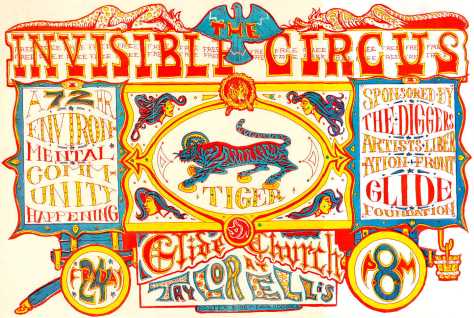
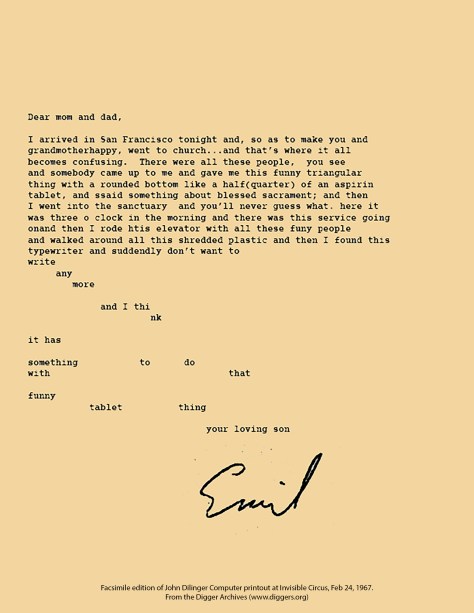
During the brief existence of the Invisible Circus, Chester and Claude set up the John Dillinger Computer instant news service in one of the backrooms at Glide Church with their Gestetner mimeograph machine and Gestefax scanner, and they churned out dozens of bulletins all night long. When I started collecting Communication Company broadsides in 1971, a friendly soul let me xerox his collection of Invisible Circus printouts. Unfortunately all the copies in the Digger Archives are now third generation copies. There are several which are iconic of the times but are now too faded to scan. I made a facsimile of one, “Dear mom and dad … from Emil” (see below). Such a gest, so typical of Com/Co’s style.
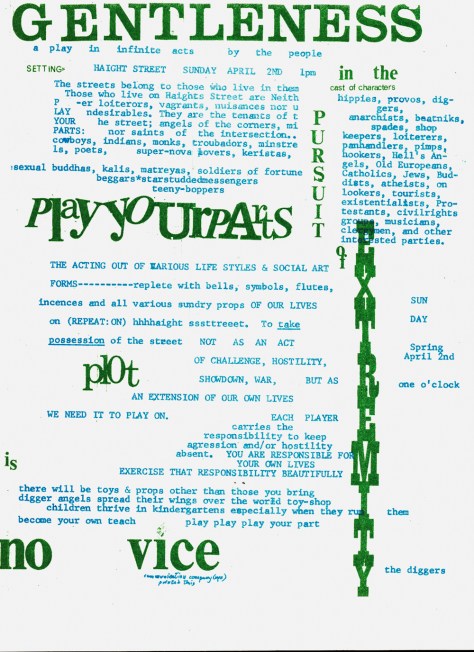
With all the talk about event planning (and permit applications, Commission refusals etc) for the 50th Anniversary of the Summer of Love, it occurred to me that it might be interesting to look back at how the Diggers planned their street events. Here’s a Digger street sheet from 1967 that outlines an event for Haight Street on April 2, 1967: “Gentleness in the Pursuit of Extremity is no vice” and it’s the perfect encapsulation of Digger-Do.
[Hoping for 2,000 signatures by Thursday, Feb. 16, 2017]
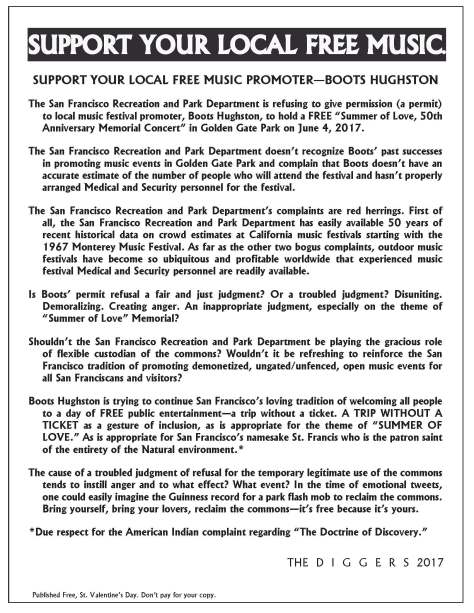
The Diggers published a “virtual street sheet” on St. Valentine’s Day (2017) about the controversy involving the San Francisco Recreation & Park Commission’s denial of Boots Hughston’s request for a permit to hold a Free Summer of Love 50th Anniversary event in Golden Gate Park. Feel free to forward this new Digger sheet to anyone who might be interested.
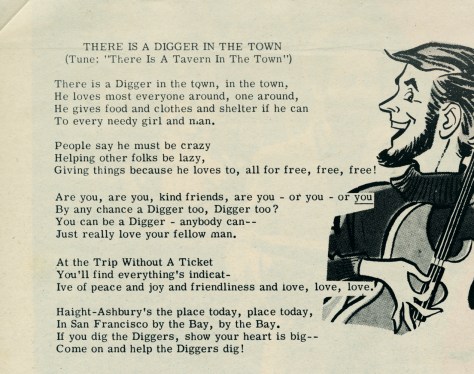
Ashleigh Brilliant was a college professor who dropped out of the academic world after taking LSD in 1965. He moved to the Haight-Ashbury in Spring 1967 and took up a career as an itinerant troubadour. This is from a collection of his songs that he published later that year. The Digger song is one of two he devotes to them.

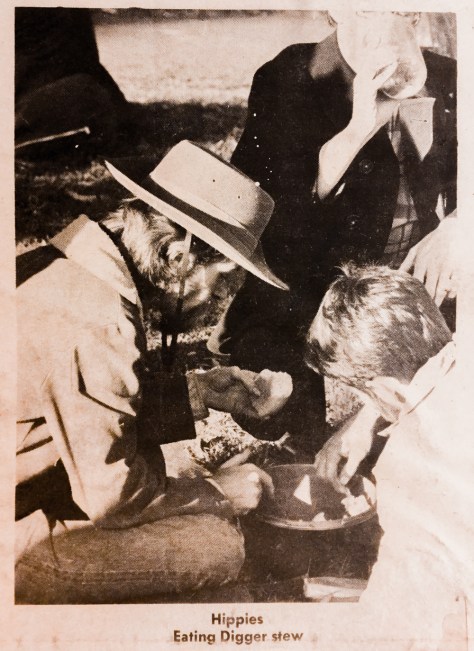
In the never-ending quest to find images from the early Digger days, here’s one I just found in a March, 1967 article from the University of San Francisco student newspaper.
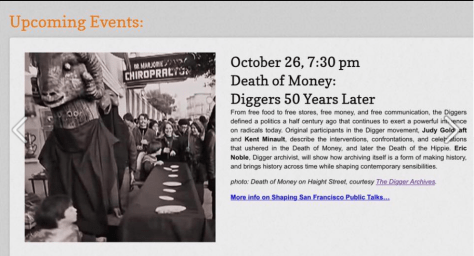
October 26, 2016 at the Shaping San Francisco people’s history studios, the Death of Money 50th Anniversary event announcement:
Audio portion of the the presentations and question/answer session that followed.
The new Digger Broadside that was distributed to the audience.
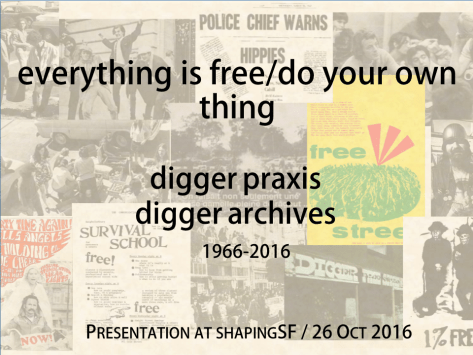
The opening slide for the first presentation of the evening.
 digger feed: dinosaurs are dancing