In June 1968, the San Francisco Diggers gave away their ultimate gift to the universe, The Digger Papers, a twenty-four-page anthology of their writings and graphics that also appeared, with a different cover page, as issue 81 of Paul Krassner’s The Realist. Among the pieces included in the collection was a four-page text headed simply “A Speech: Dialectics of Liberation.” No author was identified.
After a research trail documented below, it turns out that the speech had been delivered the previous summer at the International Congress on the Dialectics of Liberation, held at the Roundhouse in London from July 15 through July 30, 1967. The congress brought together an extraordinary collection of radical thinkers, writers, artists, and activists, including R. D. Laing, Gregory Bateson, Herbert Marcuse, Stokely Carmichael, Paul Goodman, Allen Ginsberg, Julian Beck, and Emmett Grogan (co-founder of the San Francisco Diggers with Billy Murcott). The event was conceived as something more than an academic conference. As Benjamin Serby writes, its organizers envisioned a nonauthoritarian environment in which “the planned environment would both prefigure a liberated society and give birth to the ideas necessary to its construction” (Serby 2025, 240).
Among the documents in the Emmett Grogan Papers at the New York Public Library (NYPL) are two identical thirteen-page typescripts of the speech. One copy is unedited; the other contains extensive corrections, deletions, and additions in Grogan’s hand. This is the version that appeared in The Digger Papers. NYPL has cataloged the piece as Grogan’s work. When I visited the collection in 2017, I was surprised by this attribution. I had always assumed that the author was Allen Ginsberg. I contacted the London dealer who had sold Grogan’s papers to the library. After careful consideration, he admitted that he had been mistaken, and agreed that it was Ginsberg, not Grogan. However, the library has not changed their catalog entry so far. I wanted to put this issue to rest. The discovery of a surviving transcript of the Dialectics of Liberation Congress establishes that the speech itself was not Grogan’s. It was delivered by Allen Ginsberg.

The July 27 Transcript
The crucial document is a twenty-page transcript headed “CONGRESS — DIALECTICS OF LIBERATION / Allen Ginsberg — 27th July 1967.” Preserved in Peter Davis’s Villon Films archive, it records Ginsberg’s July 27 address at the Roundhouse. I will refer to it here as the Villon transcript. Benjamin Serby independently identifies Ginsberg’s July 27 lecture and cites another audio transcript of it in the Joseph Berke Archive.
The Villon transcript preserves considerably more of Ginsberg’s address than the typescript in the Grogan Papers. It begins with Ginsberg talking about the strange effect of hearing his voice electronically amplified through the Roundhouse. He then reads at length from William Burroughs’s Nova Express. The NYPL typescript does not contain this opening material. It begins later in the speech.
The point where the texts come together is revealing. On page five of the Villon transcript, Ginsberg turns from Burroughs to the congress itself and begins reflecting upon the anxieties, paranoia, terror, and conflicting images that had manifested themselves during the preceding days. The NYPL typescript begins at essentially this point. From there, the two documents follow the same address through discussions of consciousness, language, conditioning, Flower Power, interpersonal relations, communal organization, and finally the activities of the San Francisco Diggers.
One of the most distinctive correspondences occurs almost immediately. Ginsberg recalls Gregory Bateson discussing what he calls the “scientifical apocalyptic” dimension of contemporary anxiety. He describes the accumulation of carbon dioxide in the atmosphere, a possible rise in global temperature of five degrees, the melting of the polar ice caps, and the consequent inundation of the continents by as much as 400 feet of water.
Not only does this remarkable passage appear in both the Villon and the NYPL transcripts, immediately verifying that Grogan was editing Ginsberg’s words. It also preserves an intriguing instance of the developing scientific concern over atmospheric carbon dioxide entering countercultural discourse in 1967. The Villon and the NYPL transcripts continue nearly word-for-word. Ginsberg moves through Hindu and Buddhist ideas, Chuang Tzu, Black Power, the Dalai Lama, African proverbs, shamanism, LSD, conditioning, the OSS, Hitler, J. Edgar Hoover, private fantasy and public behavior, and Flower Power.
There is another independent textual witness to Ginsberg’s authorship. In 1969 Joseph Berke, one of the organizers of the congress, published Counter Culture, a collection of material associated with the event. It included “Consciousness and Practical Action,” explicitly attributed to Allen Ginsberg. At first glance, Berke’s published text and the unedited NYPL typescript do not look particularly close. The Villon transcript resolves the problem. Berke’s “Consciousness and Practical Action” and the typescript in the Grogan Papers are different edited witnesses to the same longer Ginsberg address. Berke omitted substantial portions of the original—including the entire carbon-dioxide discussion—while retaining other passages, sometimes nearly word for word. Benjamin Serby describes the Counter Culture text as an abridged version of Ginsberg’s lecture.
The Villon transcript also resolves what might otherwise appear to be evidence against Ginsberg’s authorship. Near the end of the NYPL typescript, the speaker refers to “Allen Ginsberg” in the third person. In the Villon transcript, Ginsberg describes treating another human being simply as a person rather than as a social category: not as a role, uniform, policeman, capitalist, communist, Maoist, “Allen Ginsberg,” or self. Ginsberg was including his own public identity among the categories that he believed interfered with direct human relationships.
Grogan’s Editorial Hand
The second NYPL typescript, an exact duplicate of the unmarked copy but bearing Grogan’s handwritten edits, shows what happened to Ginsberg’s speech on its way into The Digger Papers. Grogan worked through the text with a pen, crossing out whole passages, substituting words and phrases, and adding material of his own. The manuscript in Grogan’s hand is therefore not evidence that he composed the speech. It records his work as its editor.
His most conspicuous technique is deletion. Grogan removes much of Ginsberg’s discussion of Hinduism, Buddhism, Chuang Tzu, Black Power, African proverbs, shamanism, and LSD. He heavily cuts the discussion of psychological conditioning, German youth, the OSS, and Hitler. Later he eliminates substantial digressions involving James Bevel, Vietnam, and Martin Luther King. The cuts greatly reduce the wandering, associative character of Ginsberg’s spoken performance.
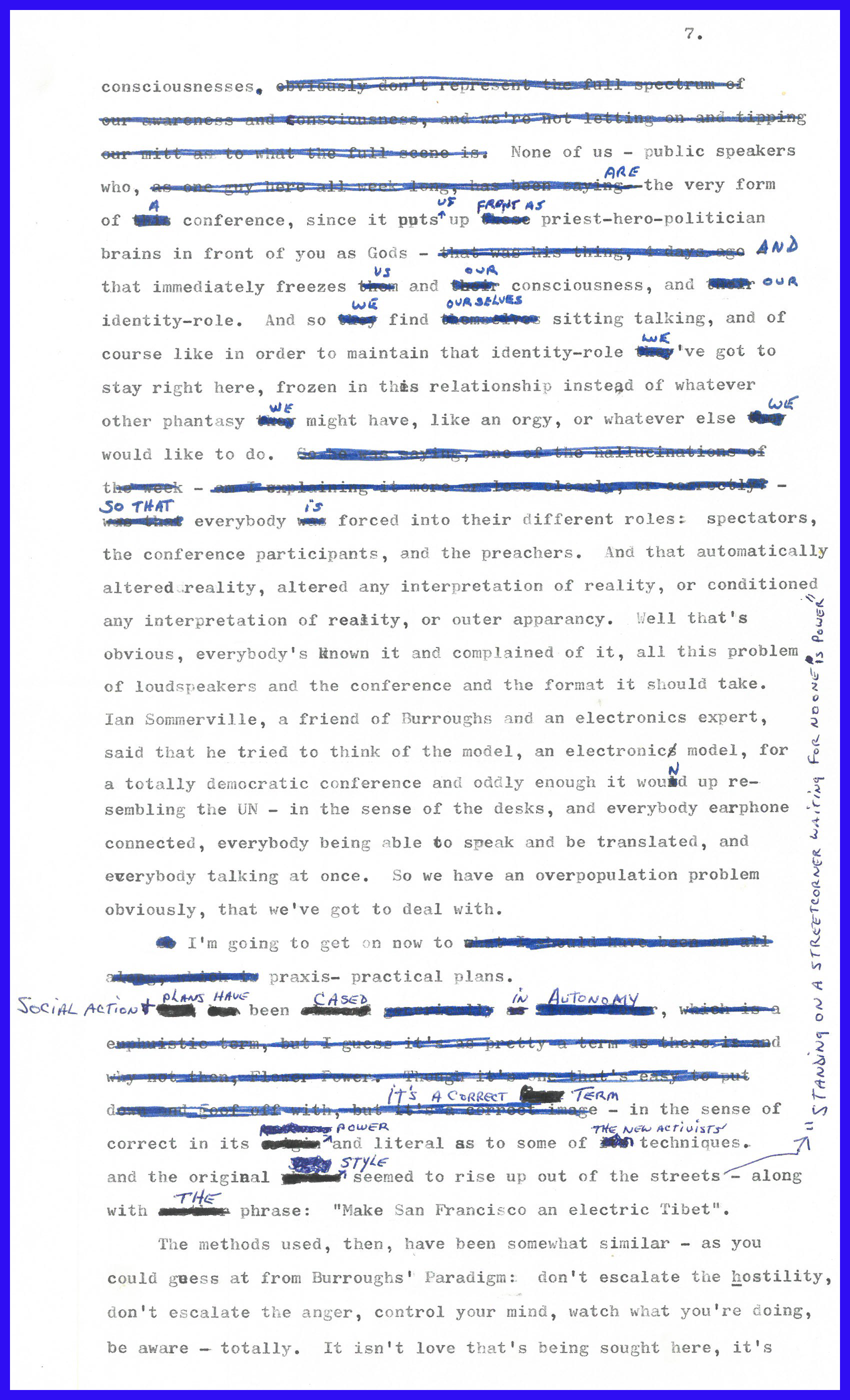
What Grogan retains is equally revealing. He preserves much of Ginsberg’s argument about manufactured public identities, interpersonal relations, the danger of treating people as images or roles, Flower Power, communal living, and practical action. The result is not a different argument so much as a concentration of one strand already present in Ginsberg’s speech.
The editing becomes particularly interesting when Ginsberg begins moving toward action. Grogan works over the transition into the Flower Power discussion, introducing such formulations as “social action + plans,” “in AUTONOMY,” and “utopia [as] praxis.” “Psycho-political action” belongs naturally to Ginsberg’s lecture and to the radical-psychiatric setting of the congress. Grogan’s praxis, social action, and autonomy move the passage toward the vocabulary of the Diggers.
This is where another surviving document becomes unexpectedly important. Peter Davis’s archive preserves a transcript of the July 22 panel in which Grogan appeared with Ginsberg, Stokely Carmichael, R. D. Laing, and David Cooper. In Grogan’s own remarks, five days before Ginsberg’s lecture, he describes young people discovering “a power—that power is autonomy,” followed immediately by the assertion that standing on a street corner waiting for no one is powerful. The conjunction is significant. In the anonymous Digger sheet “Term Paper,” autonomy is explicitly traced to Gregory Corso’s poem “Power,” the source of the image of standing on a street corner waiting for no one. Thus the connection among power, autonomy, and the street-corner image can be securely associated with Grogan independently of his handwritten emendations to Ginsberg’s typescript.
That is significant because the same language recurs throughout the early Digger writings. One of the first Digger Papers asks when Timothy Leary will stand on a street corner “waiting for no one.” Another turns the dismissive phrase “fool on the street” into the repeated declaration that the public is any fool on the street. “Term Paper” eventually joins the two formulations: the public is any fool on the street, while power consists in standing on a street corner waiting for no one. These recurring phrases amount to literary breadcrumbs. None alone proves authorship of an anonymous sheet, but together they reveal a recognizable vocabulary of autonomy, public space, action, and power.
“Term Paper” is especially suggestive. It identifies autonomy as fundamental to the Digger idea, speaks of “autonomous activity,” urges groups to pool their resources, emphasizes action and individual creative power, and ends by joining the “fool on the street” and “streetcorner waiting for no one” formulations. The convergence with Grogan’s authenticated language—both his July 22 remarks and his handwritten alterations to Ginsberg—is striking.
The handwritten conclusion of the Ginsberg manuscript provides an even stronger control sample. Grogan crosses out the typed ending and substitutes a conclusion built around “PRAXIS”:
But the only thing that will allow each of us to create his or her Utopia is praxis—and the pooling of our resources to free each of us to pursue our individual activities and strengthen the autonomous boundaries of our free cities of the now.
Here Grogan is no longer merely shortening Ginsberg. He is rewriting him.
Yet it is important not to attribute too much to Grogan. The complete July 27 Villon transcript establishes that Ginsberg himself had already spoken explicitly about the Diggers, free food, Communication Company, free stores, decentralization, and ecological consciousness. He had already argued for creating new forms of social life without waiting for some future revolution. Grogan did not introduce the Diggers into Ginsberg’s argument. He compressed, sharpened, and translated an argument already sympathetic to Digger practice into a more distinctly Digger idiom.
A Speech Moving between Two Worlds
This relationship helps explain why Ginsberg’s address lent itself so readily to Grogan’s editing. The Diggers were themselves engaged in an unusual intellectual project during 1966 and 1967. At the same time that Free Food, Free Stores, street events, Communication Company, and other forms of Digger praxis were being constructed on the streets of San Francisco, the Digger Papers were attempting to formulate an intellectual framework through which those actions could be understood.
The voices of the early Digger street sheets were not writing a common political program. Their literary methods were strikingly different. Peter Berg, who was a playwright with the San Francisco Mime Troupe, thought theatrically. In Trip Without a Ticket, the street becomes theater, social roles become roles that can be abandoned, and guerrilla theater creates liberated territory in which people can become “life-actors.” Billy Murcott’s Mutants Commune works differently. Its type-poetry, invented compounds, fragmentation, repetition, and visual manipulation of language are themselves part of its conception of mutation and communal transformation.
Grogan’s characteristic mode appears more discursive and aphoristic. Ideas recur through concrete images: the fool, the street, the street corner, waiting for no one. Around these images cluster autonomy, action, power, people, resources, and now. Grogan’s acknowledged authorship of Post-Competitive, Comparative Game of a Free City, his claim in Ringolevio to having formulated and named the “ideology of failure,” his July 22 remarks at the Roundhouse, and the words visibly inserted in his hand into Ginsberg’s speech provide points of comparison for other anonymous Digger writings, particularly Term Paper.
What emerges is a picture of Digger ideology being formulated in dialogue with practice. The theory did not precede the street experiment as a program to be implemented, nor were the writings merely retrospective explanations of actions already completed. The street generated ideas; the writings articulated them; and those formulations in turn suggested further forms of action. Theory and praxis were being constructed simultaneously.
Ginsberg’s July 27 address intersects with that project at precisely this point. He had watched the congress descend at times into struggles over authority and control. His response was to turn toward interpersonal conduct, decentralization, autonomous organization, and practical experiments already taking place in San Francisco. Serby notes that Ginsberg specifically named Grogan as a practitioner of this form of decentralized democracy (Serby, 247 n.68). When Grogan subsequently edited Ginsberg’s speech, he was therefore not working with an unrelated text. The passages he retained and the language he introduced brought Ginsberg’s argument into still closer alignment with ideas already being worked out within the Digger experiment.
From the Roundhouse to The Digger Papers
The surviving documents permit a fairly clear reconstruction. On July 27, 1967, Allen Ginsberg delivered a long, improvisational address at the Roundhouse. A twenty-page transcript survives under his name and the date of the speech. The Villon Films archive independently identifies the document as the transcript of Ginsberg’s July 27 lecture. A typescript preserving a substantial portion of that same address came into Grogan’s possession.
We cannot yet say exactly how the two transcripts are related. The thirteen-page NYPL typescript may have been excerpted from a longer transcript, independently prepared from a recording, derived from the Villon transcript, or from an earlier transcription. What can be established is that they preserve the same spoken performance.
Grogan then edited his copy extensively. The shortened and reshaped text appeared anonymously the following year as “A Speech: Dialectics of Liberation” in The Digger Papers. Meanwhile, another edited version of the same July 27 address followed a separate path through Joseph Berke and was published in Counter Culture in 1969 as “Consciousness and Practical Action,” correctly attributed to Allen Ginsberg.
There remain questions the surviving documents do not answer. We do not know who prepared the typescript that ended up in Grogan’s papers, exactly how Grogan obtained it, or whether it derives directly from the surviving twenty-page transcript. Nor do we know who decided to omit Ginsberg’s name when the edited speech appeared in The Digger Papers.
The authorship of the underlying speech, however, is no longer seriously in question. The evidence does not depend upon stylistic resemblance or the later attribution in Berke’s Counter Culture. A contemporary twenty-page transcript identifies the speaker as Allen Ginsberg and dates the speech July 27, 1967. Its text contains the distinctive passages preserved in the typescript at NYPL (cataloged as Grogan’s but which we now know is Ginsberg’s)—from Bateson and atmospheric carbon dioxide through conditioning, Hitler, Hoover, Flower Power, communal life, and the Diggers.
What the Grogan Papers preserve is not a speech written or delivered by Emmett Grogan. They preserve something in some ways more interesting: a record of one of the Diggers’ principal ideologues working editorially upon Allen Ginsberg’s words, recognizing their convergence with a developing Digger philosophy, and reshaping Ginsberg’s reflections on consciousness and practical action for their anonymous appearance in The Digger Papers.
—Eric Noble (posted 8/15/26, last edited August 21 2026)
Bibliography
Archival and Manuscript Sources
Grogan, Emmett. “Emmett Grogan Papers: 1965-1968.” Henry W. and Albert A. Berg Collection of English and American Literature, Stephen A. Schwarzman Building, Fifth Avenue at 42nd Street, New York, NY 10018. (Third Floor, Room 320)
Online collection description: NYPL Archives.
NYPL Catalog (PDF) available at: The Digger Archives.
Ginsberg, Allen. “Congress — Dialectics of Liberation: Allen Ginsberg — 27th July 1967.” Transcript, 20 pp. Peter Davis/Villon Films, Dialectics of Liberation Collection, 1967.
Available at: Villon Films.
Ginsberg, Allen. “Allen Ginsberg, July 27, 1967.” Audio transcript. Box 4, Folder 14, Joseph Berke Archive, 1960–2003. Planned Environment Therapy Archives and Special Collections, Toddington, UK. Cited in Serby, “‘A Setting Where Things Can Happen,’” 232 n. 2.
“Dialectic of Liberation: A Speech.” Typescript, 13 pp. Unedited copy. Emmett Grogan Papers, 1965-1968, Henry and Albert A. Berg Collection of English and American Literature, The New York Public Library.
Available at: The Digger Archives.
“Dialectic of Liberation: A Speech.” Typescript, 13 pp. Duplicate copy with extensive handwritten corrections, deletions, and additions by Emmett Grogan. Emmett Grogan Papers, 1965-1968, Henry and Albert A. Berg Collection of English and American Literature, The New York Public Library.
Available at: The Digger Archives.
Davis, Peter. “Group Panel.” Transcript, July 22, 1967. Dialectics of Liberation Collection, Villon Films. Panel with Stokely Carmichael, Allen Ginsberg, R. D. Laing, David Cooper, Emmett Grogan, and audience participants.
Available at: Villon Films.
Published Primary Sources
Ginsberg, Allen. “Consciousness and Practical Action.” In Counter Culture, edited by Joseph Berke, 172–81. London, 1969.
[Ginsberg, Allen.] “A Speech: Dialectics of Liberation.” In The Digger Papers, 4–7. San Francisco: Diggers, 1968. Also published in The Realist, no. 81 (August 1968): 4–7. Originally published anonymously.
Available at: The Digger Archives.
Grogan, Emmett. Ringolevio: A Life Played for Keeps. Boston: Little, Brown, 1972.
Secondary Source
Benjamin Serby, “‘A Setting Where Things Can Happen’: The Dialectics of Liberation Congress and the Politics of Knowledge in the 1960s,” Modern Intellectual History 22 (2025), 231–263.
Available at: Modern Intellectual History.
Digital Archival Collections
Davis, Peter. Dialectics of Liberation. Villon Films Archive. Collection of film, transcripts, photographs, and other materials documenting the 1967 Congress on the Dialectics of Liberation.
“Digger Writings.” The Digger Archives. Collection of Digger broadsides, manifestos, and related writings, 1966–68.
The Digger Papers. The Digger Archives.
Digital reproduction and transcription of the 1968 publication, with historical information concerning the Free and Realist editions.
“Term Paper.” Digger broadside, San Francisco, 1967. Originally published anonymously. Reproduced in “Digger Writings,” The Digger Archives.